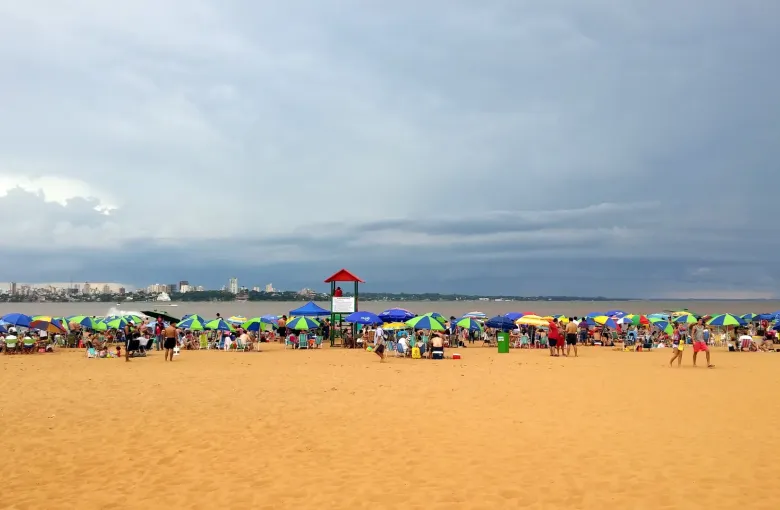
Two events dominate the Paraguayan year, they fall at opposite ends of it, and they draw completely different crowds. Around them sits a calendar of saints' days, harvest festivals and national commemorations that a visitor is likely to walk into by accident rather than plan for.
Carnaval, Encarnacion, January and February
Encarnacion runs the largest carnival in the country, on weekends across January and February, in a purpose built corridor beside the river. Comparsas compete, the costume work is serious, and the whole city gives itself over to it. It is hot, loud and late, and it is the closest Paraguay comes to a mass tourist event.
If you want it, book accommodation months ahead and expect prices to reflect the weekend. If you do not want it, note that Encarnacion is also the base for the Jesuit missions, and the missions in carnival season are a different proposition.
Caacupe, 8 December
The Feast of the Virgin of Caacupe is the country's great religious gathering. Pilgrims walk to Caacupe, many of them the whole way from Asuncion, a distance of roughly fifty kilometers, along a road that fills with walkers for days beforehand. The basilica and the town are overwhelmed and the atmosphere is unlike anything else in the Paraguayan calendar.
Visiting as an observer is entirely normal and is welcomed. Walking any part of it is also normal. Do not drive that road on the night of the seventh.
San Juan, June
Saint John's night in June is celebrated across the country with games, food stalls and fire. The set pieces involve a greased pole, a flaming ball and a burning effigy, and they are run at schools, in neighborhoods and in small towns rather than as a single national event. It is the warmest winter night of the year and the best time to eat, because every stall sells chipa, mbeju and pastel mandi'o.
The rest of the calendar
- Independence, 14 and 15 May. Two days, with the main civic ceremony in Asuncion and celebrations across the country.
- The nanduti festival at Itaugua, mid year, which is the best time to see the full range of the craft. See the Itaugua guide.
- Semana Santa. Holy Week empties the cities and fills the towns people come from, and it is when chipa is made at home in quantity rather than bought.
- Dia de la Paz del Chaco, 12 June, marking the end of the Chaco War.
Planning around them
- Dates for Carnaval and Semana Santa move with the calendar. Check the current year rather than working from last year's dates.
- Long distance buses fill around Caacupe, Semana Santa and Independence. Book ahead.
- Large gatherings and road closures interact with the blockade pattern described in the travel safety guide. Build slack into any itinerary with a fixed flight at the end.
Sources
- UK Foreign, Commonwealth and Development Office: Paraguay safety and security: the record that groups may set up blockades along the main roads and in downtown Asuncion near government buildings, that bag snatching and pickpocketing are a problem on public transport, the advice to use cash machines inside buildings and to call a licensed taxi from a landline or a hotel rather than hailing one in the street, the note that photo identification may be asked for when paying by credit card, and the assessment that although there is no recent history of terrorism in Paraguay attacks cannot be ruled out. Accessed 17 September 2026.
- UNESCO Intangible Cultural Heritage: Practices and traditional knowledge of Terere in the culture of Poha Nana, Guarani ancestral drink in Paraguay, inscribed on the Representative List in 2020, recording a drink prepared in a jug or thermos in which cold water is mixed with Poha Nana crushed in a mortar. Accessed 17 September 2026.
- UK Foreign, Commonwealth and Development Office: Paraguay travel advice: the index to the entry, safety, regional and health pages this cluster draws on, and the standing guidance that no travel can be guaranteed safe. Accessed 17 September 2026.
Other Articles
Paraguay Culture and Etiquette Guide
Paraguay and Diaspora Reconnection