Paraguay sits astride the Tropic of Capricorn and has a subtropical climate with rain spread across the whole year. That makes it unlike most of its neighbors in this region: there is no dry season to aim at and no wet season to avoid. What changes month to month is the heat, and the heat is what will shape your days.
May to September, the mild half
This is the comfortable window and the one most visitors should choose. Days are warm rather than hot, evenings are cool, and walking the Jesuit mission sites at Trinidad and Jesus de Tavarangue in open sun becomes a pleasure instead of an endurance test. June and July are the coolest months, and a cold front pushing up from the south can drop temperatures sharply for a few days at a time, so a layer you can add matters even in what is nominally a warm country.
Rain still falls in these months. It tends to arrive as a front rather than as the afternoon build and release of the summer, which means a gray day rather than an hour of downpour.
October to March, the hot half
Summer in Paraguay is genuinely hot and genuinely humid, and the middle of the day in Asuncion or in the Chaco is not the time to be outdoors. Life adjusts around it: work and errands happen early, the middle of the day empties, and things start again in the late afternoon. Visitors who fight that rhythm have a worse time than visitors who adopt it.
This is also when the country is at its most sociable. The beaches on the Parana at Encarnacion fill, the rivers and lakes around Asuncion fill, and tantalizing as an empty archaeological site sounds, the summer version of Paraguay is the one Paraguayans themselves take holidays in.
What actually decides the date
- Your tolerance for heat. This is the single biggest factor and it is not close. If you are walking mission ruins or the Chaco, the mild half is the answer.
- Carnival at Encarnacion, which runs on weekends in January and February and is the largest event in the country's calendar. See the festivals guide.
- Whether any part of the trip is on unpaved road. Heavy rain closes dirt roads in the Chaco and in the north, and a spare day stops being optional.
One health note that depends on where, not when
Paraguay's yellow fever picture has nothing to do with the season and a great deal to do with your itinerary and your route in. It is set out in full in the entry requirements guide, and it is worth reading before you book flights rather than after, because a connection through a neighboring country can change what you need.
For what each month feels like, see the weather guide, and for what to bring once the dates are settled, the packing list.
Sources
- UK Foreign, Commonwealth and Development Office: Paraguay travel advice: the index to the entry, safety, regional and health pages this cluster draws on, and the standing guidance that no travel can be guaranteed safe. Accessed 17 September 2026.
- Centers for Disease Control and Prevention: Paraguay traveler health: a yellow fever vaccine recommended for all travelers aged nine months and over except where travel is limited to the city of Asuncion, and separately a country entry requirement under which the vaccine is not required for direct travel from the United States but is required for travelers aged one year and over arriving from Bolivia, Brazil, Peru or Venezuela, counting airport transits and layovers of more than 24 hours in those countries; malaria recorded as a risk in some parts of Paraguay with no area named. Accessed 17 September 2026.
- UNESCO World Heritage Centre: Paraguay States Party record: one property inscribed on the World Heritage List, and separately twelve sites on the Tentative List that Paraguay may consider for nomination in future, among them the Jesuit Mission of San Cosme y San Damian, the rock art of Jsukaevnda and Cerro Cora, Defensores del Chaco National Park, Medanos del Chaco National Park and the Paraguayan Pantanal. Accessed 17 September 2026.
Other Articles
Paraguay Weather Guide
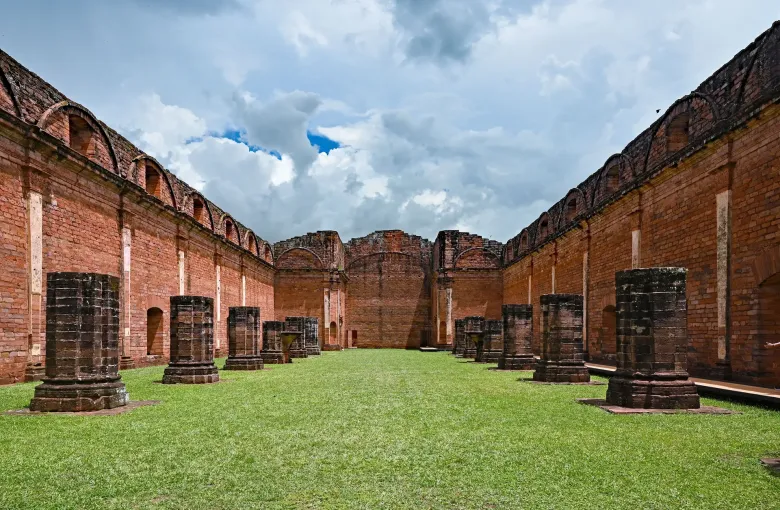
Jesuit Missions Trinidad and Jesus: Visitor and Heritage Guide