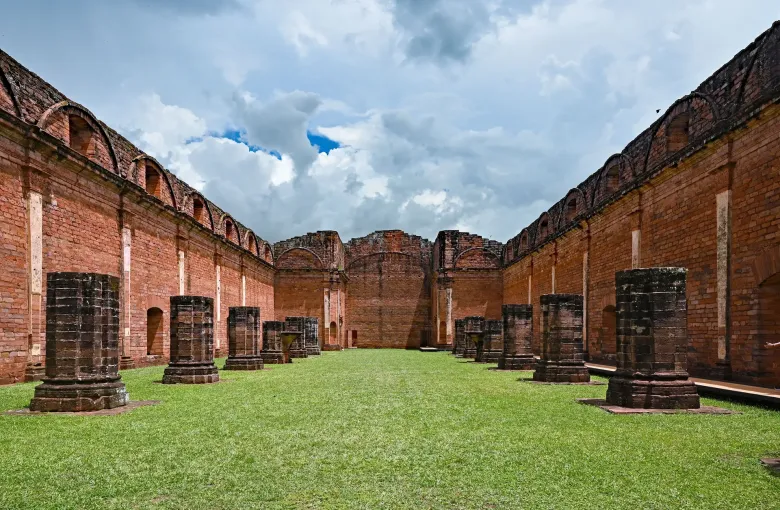
The Paraguay River splits the country into two climates, and a forecast for Asuncion tells you very little about Filadelfia. Almost every visitor stays east of the river, where the land is green, the rainfall is spread through the year and the rivers are wide. West of it lies the Chaco, a vast, thinly settled, semi arid plain that behaves like a different country.
The east: humid subtropical
Asuncion, Encarnacion, Ciudad del Este and the mission country all sit in this half. Rain comes through the whole year, usually as heavy convective storms in the warm months and as slower frontal rain in the cool ones. Humidity is high most of the year, which is why a summer afternoon here feels hotter than the number suggests.
Summer, from December to February, is hot and heavy. Autumn, in March and April, softens. Winter, from June to August, is mild by day and can be genuinely cold at night when a front comes up from Argentina. Spring, from September to November, warms quickly and brings the season's first real storms.
The Chaco: semi arid and extreme
The Chaco is drier, hotter and far more extreme in both directions. Summer temperatures here are among the highest recorded in South America, and the same place can be cold and windy in winter. Rainfall is concentrated in the warm months and much of it evaporates or disappears into the sandy ground. Surface water is scarce and saline, which is why the lagoons have the pale crusted margins you see rather than green banks.
This has practical consequences. Distances between settlements are long, services are few, and a vehicle problem is a more serious matter than it would be in the east. The travel safety guide covers what that means in practice.
Month by month, in general terms
- December to February. Hot and humid in the east, very hot in the Chaco. Afternoon storms are common and can be violent. Plan around the middle of the day.
- March to May. The most pleasant stretch of the warm half. Heat eases, storms become less frequent, and the countryside is still green.
- June to August. Mild days, cool to cold nights, occasional cold fronts. The best walking weather of the year, and the best light for photographs.
- September to November. Warming, with the return of humidity and of storms. Jacaranda and lapacho flower, which is worth timing for if you care about such things.
What the weather asks of you
In the warm months the answer is shade, water and a schedule that respects the afternoon. In the cool months it is a layer for the evening and a waterproof for frontal rain that can settle in for a day. In either, a hat is not optional, and the sun is stronger than the temperature implies. The packing list works through it.
Sources
- UK Foreign, Commonwealth and Development Office: Paraguay travel advice: the index to the entry, safety, regional and health pages this cluster draws on, and the standing guidance that no travel can be guaranteed safe. Accessed 17 September 2026.
- Centers for Disease Control and Prevention: Paraguay traveler health: a yellow fever vaccine recommended for all travelers aged nine months and over except where travel is limited to the city of Asuncion, and separately a country entry requirement under which the vaccine is not required for direct travel from the United States but is required for travelers aged one year and over arriving from Bolivia, Brazil, Peru or Venezuela, counting airport transits and layovers of more than 24 hours in those countries; malaria recorded as a risk in some parts of Paraguay with no area named. Accessed 17 September 2026.
Other Articles
Best Time to Visit Paraguay
Paraguay Packing List