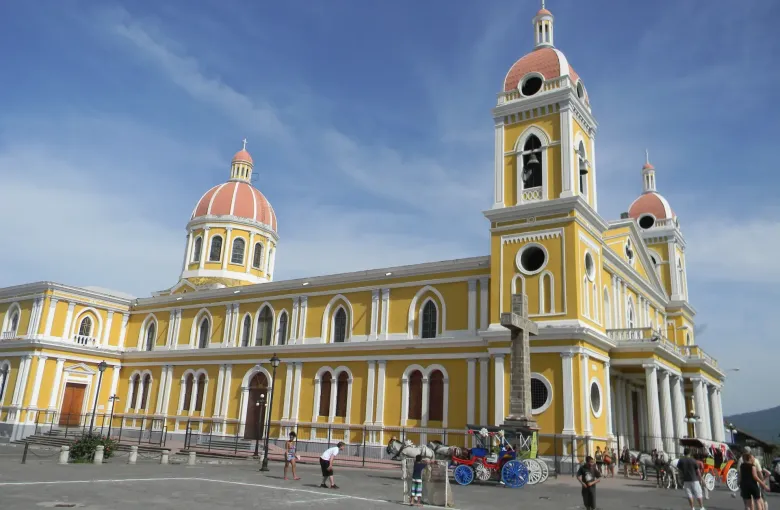
Leon is the ecclesiastical and intellectual capital of Nicaragua, a university city of low colonial streets and enormous churches, hotter and less polished than Granada and considerably more serious. At its center is the largest cathedral in Central America.
⚠ Two places called Leon, and they are not the same place
This has to come first, because almost every visitor meets the confusion sooner or later. Nicaragua has two properties inscribed on the World Heritage List, and both carry the name Leon.
- Leon Cathedral, the Cathedral of the Assumption of the Blessed Virgin Mary, was inscribed in 2011. It stands in the middle of the living city and it is what this guide is about.
- The Ruins of Leon Viejo were inscribed in 2000. They are the excavated remains of the original Spanish settlement, near the town of Puerto Momotombo at the western end of Lake Managua, 68 km from the capital and roughly 30 km from the modern city.
They are two separate inscriptions, two separate sites and four centuries apart. Leon Viejo was founded in 1524 by Francisco Hernandez de Cordoba, partially destroyed by the eruption of Momotombo in 1578, and finished off by the earthquake of 1610, after which the city was moved to where it stands today. Visiting one does not mean you have visited the other.
The cathedral
The building took most of a century to complete and its scale is startling in a city this size. The interior is cool and white, and Ruben Dario, the poet who matters more to Nicaraguans than any politician, is buried here.
The thing to do is go up. The roof is a broad white landscape of domes, balustrades and finials, painted brilliant white and walkable. From it you can see the volcanic chain running north, and on a clear day the whole line of cones. Shoes usually come off before you step onto the roof surface, so wear socks you do not mind, and go early or late, because the white reflects heat as effectively as it reflects light.
The rest of the city
Leon is a walking city. The churches are the point, and there are many more of them than the cathedral. The revolutionary murals are part of the recent history and are still being added to. The Ruben Dario museum is in the house where he lived. The whole center can be covered on foot in a day, though the heat argues for splitting it into a morning and a late afternoon.
Cerro Negro
The young black cinder cone outside the city is the reason many people come to Leon at all, and boarding down its slope is the best known adventure activity in the country. It is genuinely volcanic terrain: go with an experienced guide, wear closed shoes and expect to find black grit in your belongings for the rest of the trip.
Practicalities
Leon is hot, hotter than Granada, and the middle of the day is not the time for the roof or the streets. It is easily reached by bus from Managua and from Granada, which has its own guide in this cluster. Note that the cached health record lists Leon among the departments with rare cases of malaria, so bite avoidance is sensible here even though the city is not in the main transmission area, and any decision about prophylaxis belongs with a travel health clinician.
Sources
- UNESCO World Heritage Centre: Leon Cathedral, inscribed 2011, the Cathedral of the Assumption of the Blessed Virgin Mary in the living city of Leon, a separate property from the Ruins of Leon Viejo and about 30 km from them. Accessed 17 September 2026.
- UNESCO World Heritage Centre: Ruins of Leon Viejo, inscribed 2000, one of the oldest Spanish colonial settlements in the Americas, located near the town of Puerto Momotombo at the western end of Lake Managua 68 km from the capital, founded in 1524 by Francisco Hernandez de Cordoba, partially destroyed by the eruption of Momotombo in 1578 and finished by the earthquake of 1610. Accessed 17 September 2026.
- UNESCO World Heritage Centre: Nicaragua States Party record: two properties inscribed on the World Heritage List, and separately a Tentative List of sites the country may consider for nomination in future, among them the City of Granada and its natural environment, the Fortress of the Immaculate Conception, the Miskitos Keys and Volcan Masaya National Park. Accessed 17 September 2026.
- Centers for Disease Control and Prevention: Nicaragua traveler health: a yellow fever record under which the vaccine is not recommended for travel to Nicaragua while a certificate is required of travelers arriving from a country with risk of transmission, and a malaria record naming the Region Autonoma Atlantico Norte and the Region Autonoma Atlantico Sur as transmission areas, rare cases in the departments of Boaco, Chinandega, Esteli, Jinotega, Leon, Matagalpa and Nueva Segovia, and no malaria transmission in Managua. Accessed 17 September 2026.
Other Articles
Best Time to Visit Nicaragua
Nicaragua Packing List