This guide sets out what the ground is actually like, so you can plan against facts rather than against hope. Nicaragua has limited accessible infrastructure, and the honest position is that a trip here needs more arrangement than the same trip in North America or Europe, not that it cannot be done.
Streets and pavements
The colonial centers of Granada and Leon are the reason most people come and the hardest surfaces to cross. Expect cobbles, uneven stone, high curbs, steps into shops and pavements that narrow or disappear. Granada is flatter than Leon and the area immediately around its central park is the most manageable in the country. A manual chair will usually need a companion; a lightweight chair travels better than a heavy powered one, given the terrain and the difficulty of finding repairs.
Accommodation
Newer hotels in Managua and the larger Granada properties are the best prospects for step free access, lifts and adapted bathrooms. Colonial conversions are charming and rarely accessible: interior courtyards, thresholds and stairs are intrinsic to the building. Ask for specific measurements rather than asking whether a hotel is accessible, because the word means different things to different people. Door widths, the height of the bed, whether the bathroom has a step and whether there is a roll in shower are the questions that get useful answers.
Transport
Public buses are not accessible. The realistic approach is a private vehicle with a driver arranged in advance, which is affordable by North American standards and removes most of the friction from a trip. Taxis are small and rarely adapted. If you use them, use a radio dispatched taxi or an authorized taxi with red plates, as the safety guidance directs for all travelers. The transport guide in this cluster covers the rest of the network.
The boat and volcano legs
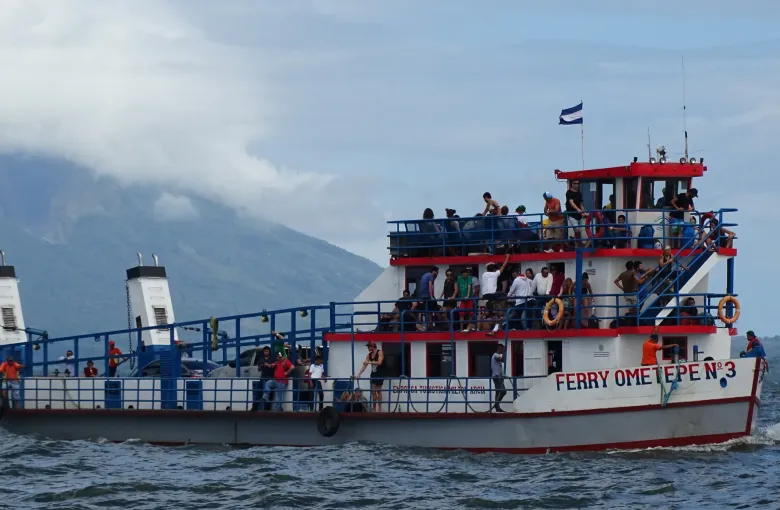
Two of the country's signature experiences are difficult to adapt. The Ometepe ferry involves boarding a working vessel from a dock, often with a step and a gangway and sometimes in a swell. Volcano access involves loose ground, no made paths and no handrails, and the standing national advice is not to hike on volcanoes without an experienced guide.
Both can sometimes be arranged with enough notice and the right operator, and both need honest conversation in advance rather than an attempt on the day. Las Isletas by boat from Granada is often the more achievable water experience, since it leaves from a fixed dock.
Healthcare and evacuation
Check before you travel that your destination can provide the healthcare you may need, and take travel insurance that covers unexpected medical evacuation as well as treatment. That matters more here than in many places: there is no resident British diplomatic mission, and the only hyperbaric chamber in the country is at Puerto Cabezas. Bring all prescription medication and any consumables for the whole trip in original labeled packaging, with spares, because pharmacy stock is limited outside the main cities and very limited on the Caribbean coast.
What to arrange before you go
- A private vehicle and driver for the whole itinerary rather than leg by leg.
- Written confirmation of door widths, step heights and bathroom layout at each hotel.
- A conversation with any boat or volcano operator well in advance, not on the day.
- Insurance that explicitly covers medical evacuation.
- Spare parts, consumables and medication for the full trip.
Sources
- UK Foreign, Commonwealth and Development Office: Nicaragua safety and security: the record that it is illegal for foreigners to take part in any sort of political activity, that arrest, detention or deportation can follow from anything seen as acting against the government including campaigning or protesting with the national flag or colors, the express kidnapping risk attached to unauthorized taxis and the advice to use a radio dispatched taxi or an authorized taxi with red plates with the driver's ID number, name and photograph visible on the dashboard, the advice to avoid colectivos and never to take a taxi called by a stranger, the assault risk in changing money on the street, the prohibition on the possession and use of drones under Law 1230 of December 2024, the rule that right hand drive vehicles may not be driven or imported, the likelihood of detention after a serious or fatal road traffic accident, the absence of street lighting on the main highways, the hurricane season from June to November, the active volcanoes San Cristobal, Masaya, Cerro Negro, Telica and Concepcion, the fatalities from scuba diving off the Caribbean coast, and the record that the country's only hyperbaric chamber is in Puerto Cabezas, a 5 hour speedboat ride from Corn Island. Accessed 17 September 2026.
- UK Foreign, Commonwealth and Development Office: Nicaragua travel advice: the index to the entry, safety and health pages this cluster draws on, the standing guidance that no travel can be guaranteed safe, the record that there is no resident British diplomatic mission and that emergency and passport help comes from the British Embassy in San Jose, Costa Rica, and the note that replacement travel documents may take up to 4 weeks longer than normal to reach you. Accessed 17 September 2026.
- UK Foreign, Commonwealth and Development Office: Nicaragua health: the emergency medical number 911, and the guidance on travel insurance, on unexpected medical evacuation and on checking before travel that a destination can provide the healthcare a traveler may need. Accessed 17 September 2026.
Other Articles
Nicaragua for Senior Travelers
Granada: Visitor and Heritage Guide