The short version.
The most useful accessibility fact about New Zealand is that its outdoors is graded. Tracks run from wide, firm, even paths suitable for a great many people to alpine routes that demand equipment and experience, and the distance between those two ends is much larger than the word walk suggests.
So the question that gets you a good answer is not whether a place is accessible. It is what the surface is, how long it is, how much it climbs, and what happens if the weather turns.
Read the grade, not the name.
A great deal of what visitors want to see here is reached by a short, well formed path from a parking area, and those paths are genuinely usable by people who could not manage a hill walk. Others share the same landscape and are a different proposition entirely.
The Tongariro Alpine Crossing is the clearest illustration. The Department of Conservation publishes conditions in which to reconsider it: an average wind speed of 55 kph or greater, or a wind chill of minus 10 degrees Celsius or colder. A route with published wind thresholds is not a walk in the ordinary sense, whatever the season, and nothing about it is easy.
The useful move is to ask, for each place on the itinerary, which kind of track reaches it. Many of the country's landscapes have both.
Preparation is assumed of everyone.
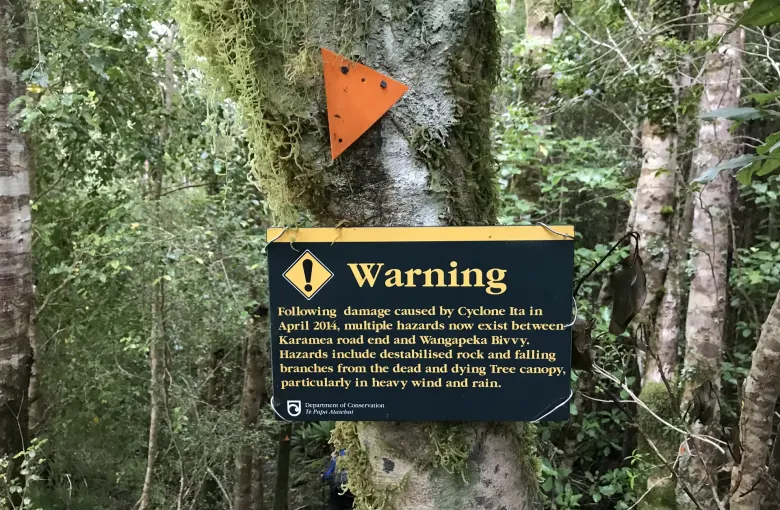
The Department of Conservation asks visitors to always be prepared for your trip, and that expectation does not soften for anybody. If a track is longer or more exposed than it looked, the answer is to know that before you start rather than to find out halfway.
For a traveler managing fatigue, a mobility condition or a chronic illness, that principle is an ally rather than an obstacle, because it means the information tends to exist. Track surface, distance and climb are published in a way that many countries do not publish them.
Health and medication.
The UK Foreign, Commonwealth and Development Office advises seeking health advice at least 8 weeks before a trip, names Healthline for free medical advice, and advises holding travel insurance for local treatment or unexpected medical evacuation. For anyone traveling with a condition, all three of those matter more, not less.
Bring a full supply of any regular medication in original labeled packaging, and be aware that it must be declared if the biosecurity rules touch it.
Museums and city attractions.
The Museum of New Zealand Te Papa Tongarewa states that entry is free for New Zealanders and people living in New Zealand and that international visitor tickets are sold separately. Major public institutions are generally the easiest part of an itinerary to make work, and they are worth using as anchors on days when the outdoors is not the right choice.
What this page cannot tell you.
No source in this cluster's research register publishes accessibility ratings for New Zealand accommodation, transport or individual attractions. There is no list here of step free hotels or of which tracks are wheelchair rated, and inventing one would be worse than useless: an access claim that turns out to be wrong strands somebody.
What this page gives you instead is the right question and the reason it works. Ask about the surface and the gradient, in writing, for each specific place.
Before you book.
Tell us precisely what the requirement is rather than the category it falls into, because step free, short distance and firm surface are three different needs and a property may meet one and not the others. We will confirm each one with the operator in writing before anything is booked, and we will build the itinerary so no single day depends on a track nobody has described to you.
Sources
- New Zealand Department of Conservation: asks visitors to take care of Aotearoa and to always be prepared for a trip, and states that everyone who lives and travels here has a responsibility to look after it. Accessed 22 September 2026.
- New Zealand Department of Conservation: records that Tongariro is a World Heritage site for its cultural values, that the mountains are sacred to Ngāti Hikairo ki Tongariro of Ngāti Tūwharetoa and asks visitors to honor the requests of Ngāti Hikairo by staying safe and respecting their home, notes that Manaaki Rangers greet visitors daily from November to April and that bookings are recommended for all visitors, and gives an average wind speed of 55 kph or greater and a wind chill of minus 10 degrees Celsius or colder as conditions in which to reconsider. Accessed 22 September 2026.
- UK Foreign, Commonwealth and Development Office: instructs a caller to dial 111 and ask for an ambulance, advises seeking health advice at least 8 weeks before a trip, states that British nationals who live in the UK and who are on a short-term visit to New Zealand are eligible for urgent healthcare treatment under a reciprocal agreement that does not extend to routine, non-emergency medical treatment including prescriptions, names Healthline for free medical advice, and advises holding travel insurance for local treatment or unexpected medical evacuation. Accessed 22 September 2026.
- Museum of New Zealand Te Papa Tongarewa: states that museum entry is free for New Zealanders and people living in New Zealand and that international visitor tickets are sold separately. Accessed 22 September 2026.
Other Articles
New Zealand for Senior Travelers
Getting Around New Zealand