History
Marrakesh was founded in the eleventh century by the Almoravids and became the capital that gave the country its name in several European languages. Its red pisé walls, its gardens and its position below the High Atlas made it the great southern city, and it was the political center under the Almohads and again under the Saadians.
The medina was inscribed on the UNESCO World Heritage List in 1985 as site number 331.
Marrakesh is unusual in carrying two kinds of UNESCO recognition. The medina is a World Heritage Site, a matter of buildings and urban fabric. Separately, the cultural space of Jemaa el-Fna was proclaimed a Masterpiece of the Oral and Intangible Heritage of Humanity in 2001 and incorporated into the Representative List of the Intangible Cultural Heritage of Humanity in 2008. That second listing protects a practice rather than a place: the storytellers, musicians, acrobats and healers who gather in the square. It was one of the first inscriptions of its kind anywhere and it is the reason the square is more than a market.
What you will see
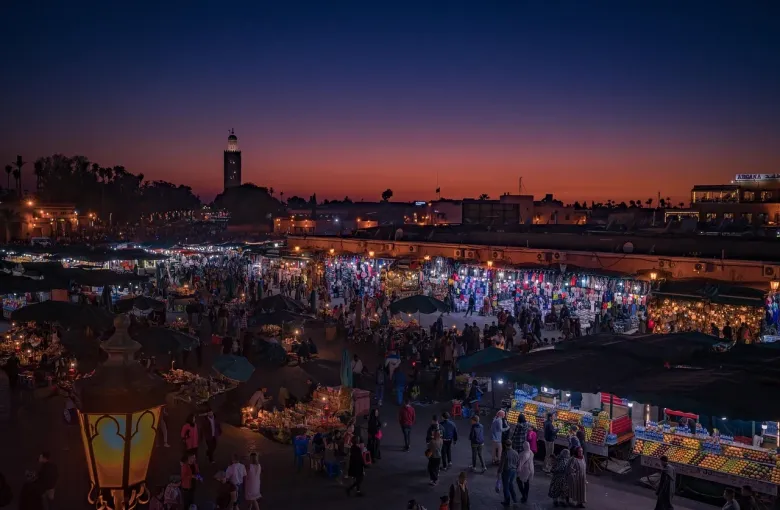
- Jemaa el-Fna. A wide, ordinary-looking square by day that becomes an open-air theater and kitchen at dusk: orange juice carts, storytellers, Gnawa musicians, and rows of numbered food stalls.
- The Koutoubia Mosque and its twelfth-century minaret, the template for the Giralda in Seville and the Hassan Tower in Rabat. The interior is closed to non-Muslims; the exterior and gardens are the visit.
- The Saadian Tombs, sealed up for centuries and reopened in the twentieth: the finest surviving Saadian interiors in the country.
- The Bahia Palace, a late nineteenth-century palace of courtyards, painted cedar ceilings and zellij.
- The Ben Youssef Madrasa, restored, and the most beautiful single interior in the medina.
- The souks, running north from the square, organized loosely by trade.
- The Majorelle garden and the Yves Saint Laurent museum, outside the walls in Guéliz, and the calmest hour you will spend in the city.
Visiting
- See the square twice, once in the afternoon and once after dark. They are different places.
- A rooftop cafe on the square at sunset is the best value in Marrakesh.
- Agree prices before anything happens. Photographs of performers, a bowl of food, a henna design: all fine, all expected to be paid for, all better settled in advance.
- Expect a persistent approach in the souks. Firm and friendly works.
- The medina is walkable but disorienting. It is easier than Fez, and a guide is still worth it on the first morning.
- Two full days covers the monuments and the souks without a rush.
Getting there
Marrakesh Menara airport is fifteen minutes from the medina and has wide European connections. Trains run from Casablanca in around three hours and from Fez in about seven. The high-speed line is being extended southward toward the city. Vehicles cannot enter most of the medina; taxis drop at the nearest gate.
Visiting respectfully
Jemaa el-Fna is inscribed because of the people in it, so the courtesy owed is to them: ask before photographing, pay when a photograph is the transaction, and give the storytellers an audience rather than a passing camera. Dress modestly in the medina, even though Marrakesh is used to visitors. Do not enter the Koutoubia or working mosques if you are not Muslim.
Visiting with LABUSA Travel
The Colors of Morocco tour ends in Marrakesh with two nights, which is the right amount of time here, and dinner under the lights of the square.
Sources
- UNESCO World Heritage Centre: the inscription of Morocco’s nine World Heritage Sites. whc.unesco.org. Accessed 11 August 2026.
- UNESCO Intangible Cultural Heritage: Morocco’s inscribed elements and which of the two lists each sits on. ich.unesco.org. Accessed 11 August 2026.
- Moroccan National Tourist Office: official destination, region and practical visitor information. visitmorocco.com. Accessed 11 August 2026.
Other Articles
Medina of Fez: Visitor and Heritage Guide
Morocco Food Guide