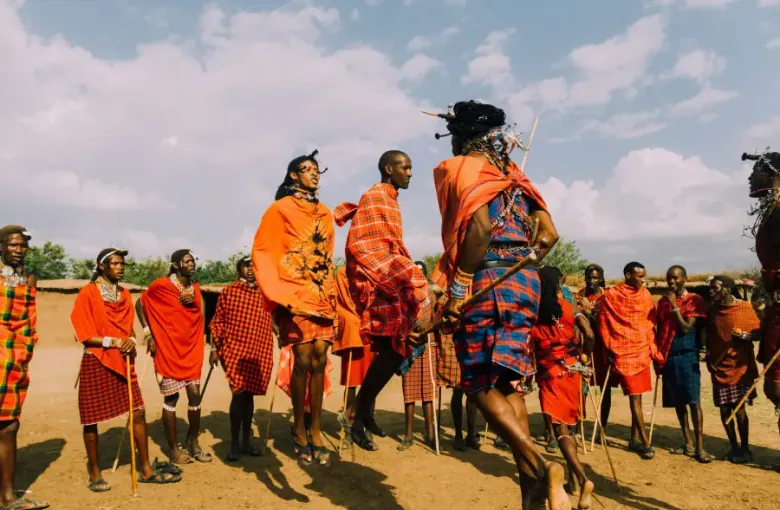
Start here: Kenya’s story is not Ghana’s
Travelers who have visited West Africa often arrive in Kenya expecting the same heritage architecture — the slave forts, the door of no return, the framework of transatlantic return that Ghana has built so deliberately. Kenya does not have that, and pretending otherwise does the country and the visitor a disservice.
Kenya’s connections to the wider Black world run along different lines: the deep human past, a thousand years of Indian Ocean exchange, an Indian Ocean slave trade that was real and is far less discussed than the Atlantic one, and a twentieth-century independence struggle that mattered enormously to Black political thought worldwide. Each of those is a genuine thread to follow. None of them is the West African one.
The deep past
Northern Kenya’s Turkana Basin has produced some of the most significant hominin fossils ever found, and the National Museums of Kenya holds and interprets that material. For a visitor for whom "reconnection" means something older and broader than a single displacement, this is extraordinary ground — the evidence that the human story begins in this region, held in the country where it was found.
The Nairobi National Museum is the practical place to encounter it, and it is a serious museum rather than a stop.
The Indian Ocean world
The Swahili coast was a cosmopolitan trading civilization for centuries, connected to Arabia, Persia, India and China, and Swahili itself is the language that grew out of that exchange. Lamu Old Town and the historic quarters of Mombasa are the surviving fabric of it.
That trade included the trade in enslaved people, moving east and north rather than west. It is less written about, less memorialized, and no less real. A visitor who wants to understand it should say so, because it is not the story the coast leads with.
Independence, and what it meant elsewhere
Kenya’s independence struggle, and the Mau Mau uprising within it, was followed closely by Black communities across the world and shaped anti-colonial and civil rights thinking well beyond East Africa. The historical sites, the museum collections and the national days are the visible part; the more interesting part is usually a conversation with someone whose family lived it.
This history is contested and still politically live in Kenya. Approach it as something to be learned rather than something you already have a position on.
The contemporary diaspora
Kenya has a large and active diaspora, particularly in North America and the UK, and the traffic runs both ways: return visits, family obligation, investment, and people moving back. Nairobi is a technology and business hub with a genuine returnee community. For a Kenyan-descended traveler this is often the most substantial part of a trip, and it is not a heritage-tourism product — it is family, and business, and a city.
Going well
- Say what you are looking for. "Heritage" means different things and Kenyan guides will tailor to it if you are specific.
- Give the museums real time. The interpretive work is where the substance is.
- Ask about the Indian Ocean trade explicitly if that is what you want to understand.
- Allow for the emotional weight of some of this. It is not a sightseeing schedule.
- Spend money where it stays — community-run visits, local guides, local businesses.
Common questions
Is there a Kenyan equivalent of Ghana’s Year of Return?
Not in the same organized form. Kenya’s diaspora relationship is real but is expressed through family, investment and business more than through a heritage-tourism program.
Where should I start?
The Nairobi National Museum, then the coast if the Indian Ocean thread interests you, then the independence history with a guide who can place it.
Can I trace family connections?
For Kenyan-descended travelers, often yes, through family networks. For African American travelers, the transatlantic trade did not principally draw from this coast, and honest guidance matters more here than encouragement.
Seeing it on a LABUSA Travel journey
We will build this properly if you tell us it matters — museum time with a guide who knows the collections, coastal history treated as history, and space in the schedule for the parts that are not sightseeing. We would rather set the expectation accurately in advance than have you discover the difference on arrival.
Other Articles
Kenya Culture and Etiquette Guide

Nairobi National Park: Visitor and Heritage Guide