The quick answer
Italy is harder than northern Europe and better than its reputation. The difficulty is physical and historical rather than attitudinal: cobbled streets, buildings that predate the idea of an elevator, and towns built up hillsides for defense. Against that, the major museums are mostly well adapted, the rail network offers real assistance, and Italian staff are generally willing to help rather than to explain a policy.
The way to travel well here is to plan in detail and to be selective, rather than to hope.
The ground itself
Roman sampietrini, the square basalt setts, are the defining surface of central Rome and are hard work in a manual chair and jarring in a powered one. Medieval towns add gradients and steps. Curb cuts exist but are inconsistent, and cars park across them. Where you can, favor a powered chair or a companion for the historic centers, plan shorter distances than you would at home, and build rests into the day rather than at the end of it.
Cities that work better than others
- Rome is mixed. Metro line B is largely step-free and line A largely is not, buses are mostly low-floor, and the major sites have adapted entrances. The ancient sites have been substantially improved, with lifts and accessible routes now serving parts of the Colosseum and the Forum area.
- Milan, Turin and Bologna are the easiest of the big cities: flatter, more modern in their fabric, and better served by accessible public transport.
- Florence is compact and flat, which helps, but the historic paving and narrow sidewalks do not.
- Hill towns, including most of the famous ones in Tuscany and Umbria, are honestly difficult. Some have installed lifts or escalators from the parking areas below; check before committing a day to one.
Venice, which is not what you expect
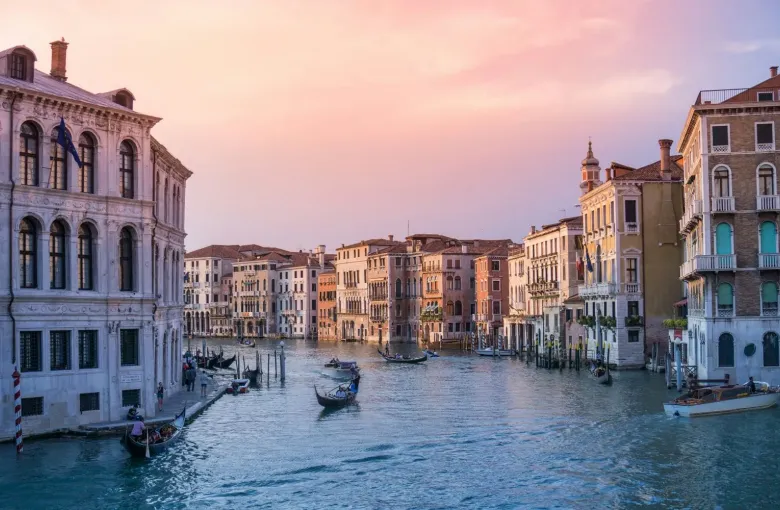
Venice has no cars, which removes one problem, and roughly four hundred bridges, which creates another. It is nevertheless more manageable than its reputation, for one reason: the vaporetto water buses are the public transport, and the main lines and landings are largely step-free. Boats do the work that walking does elsewhere.
The practical approach is to base yourself near a landing, use the water buses along the Grand Canal, and accept that some of the back streets are not reachable. St Mark’s Square, the Rialto area and the main islands of the lagoon are all approachable from the water. A gondola is not an accessible vehicle, and the traghetto crossings are not either.
Trains and flights
Italian railways provide free assistance for passengers with reduced mobility at the larger stations, including help to and from the platform and boarding with a ramp. It must be booked in advance, and the notice required is longer than most people expect, so arrange it when you buy the ticket rather than on the day. High-speed trains have designated wheelchair spaces that are limited in number and sell out.
Airports are obliged to provide assistance from arrival at the terminal through to the aircraft door, arranged through the airline at booking. Notify the airline of a powered wheelchair’s battery type well ahead of the flight.
Museums, churches and hotels
The Vatican Museums, the Uffizi and the large state museums have step-free entrances, elevators and reduced or free admission for a disabled visitor and a companion, usually with priority entry that avoids the queue. Ask at the dedicated entrance rather than joining the main line. Many churches have a side ramp even where the main steps suggest otherwise.
Hotels are the place to be most careful. An Italian hotel described as accessible may have a single adapted room, a small elevator that a chair does not turn in, or a step at the front door that nobody mentioned. Ask for measurements and photographs, specifically of the door widths, the elevator car and the bathroom, and do not rely on a star rating or a booking-site icon.
Planning with LABUSA Travel
Tell us precisely what you need and we will verify it rather than assume it: we measure doorways, confirm assistance bookings, and design the route so the days that are hard are followed by days that are not.
Sources
- Trenitalia: the national rail network, ticket types, and assistance for passengers with reduced mobility. trenitalia.com. Accessed 11 August 2026.
- ENAC, Italian Civil Aviation Authority: air passenger rights and the assistance airports must provide. enac.gov.it. Accessed 11 August 2026.
- Musei Vaticani: visiting arrangements, dress requirements and accessibility at the Vatican Museums. museivaticani.va. Accessed 11 August 2026.
- Gallerie degli Uffizi: opening arrangements and advance booking for the Uffizi and the Boboli Gardens. uffizi.it. Accessed 11 August 2026.
Other Articles
Italy for Senior Travelers
Getting Around Italy