History
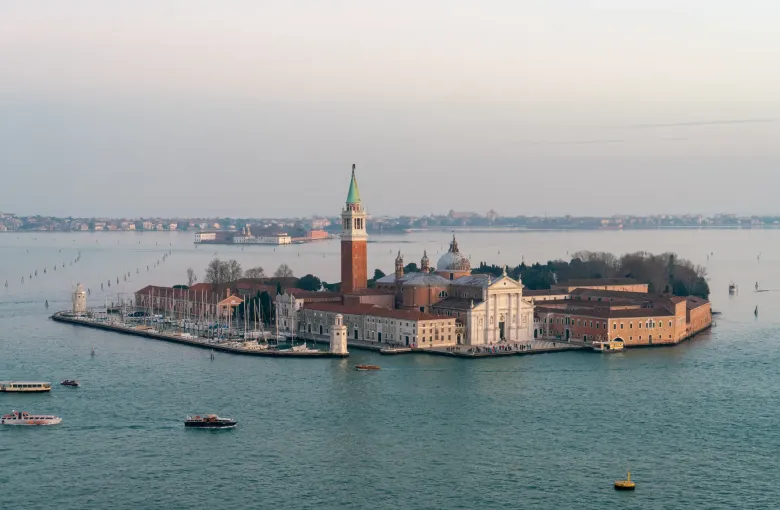
Venice and its Lagoon was inscribed on the World Heritage list in 1987, and the name matters: the property is not only the famous city but the whole lagoon around it, including the outlying islands and the shallow water and marsh between them. The city and the lagoon are one artificial system, built and maintained together for more than a thousand years, and neither survives without the other.
Venice was founded by mainland refugees on mud banks and became a maritime republic that dominated Mediterranean trade for centuries. Because it faced east, its art and architecture absorbed Byzantium and the Islamic world in a way the rest of Italy did not, which is why St Mark’s looks like nothing else in the country.
What you will see
- St Mark’s Basilica and its square, with the golden mosaics and the four bronze horses brought back from Constantinople.
- The Doge’s Palace, the seat of the republic’s government, and the Bridge of Sighs behind it.
- The Grand Canal, best seen slowly from the deck of a water bus rather than from a bridge.
- Murano, where the glass furnaces were moved in the thirteenth century to keep fire away from a wooden city, Burano with its painted houses and its lace, and Torcello, the first island settled and now nearly empty, with a cathedral whose mosaics are older than almost anything in Venice itself.
- The quiet sestieri, Cannaregio and Dorsoduro, ten minutes and one bridge away from the crowds.
Visiting
Venice is walking and boats. The vaporetti are the public transport and a travel pass for the length of your stay is far better value than single tickets. A gondola is an experience rather than transport, and its fare is set by the city rather than negotiated, so agree what you are getting before you step in. The two-minute traghetto ferries across the Grand Canal are the cheapest boat ride in the city and the way locals cross it.
Acqua alta, the seasonal high water, floods the lowest parts of the city for a few hours at a time mostly between October and January. The city forecasts it, raises walkways on the main routes, and carries on. Bring boots or buy overshoes, and plan around the tide table rather than against it.
The city has introduced an access fee for day visitors on certain busy days. Arrangements have changed since it was first trialed and the city’s own site is the authority, so check it while booking. Overnight guests are treated differently from day trippers, since they already pay the accommodation tax.
Getting there
Trains and cars arrive at the western edge, and everything beyond that is on foot or on water. Marco Polo airport connects by bus to Piazzale Roma or, more memorably, by boat across the lagoon. Leave the car in the garages at Piazzale Roma or on the mainland at Mestre, which is considerably cheaper. Pack light: there will be bridges with steps between you and your hotel.
Visiting respectfully
Venice is the clearest case in Italy of a living city under pressure from the number of people who want to see it, and its resident population has fallen sharply. The things that help are simple: stay overnight rather than passing through, spend money with Venetian businesses, visit the outer islands and the quieter sestieri, and come outside the peak if you can.
Sitting or lying on the ground in St Mark’s Square, picnicking on monuments, swimming in the canals and feeding the pigeons are all prohibited and fined. Covered shoulders and knees are required in the basilica, and large bags must be left at the deposit nearby.
Planning with LABUSA Travel
Venice closes the Essence of Italy itinerary with three nights, a guided city day and a lagoon day out to Murano, Burano and Torcello, which is the part of the inscription most visitors never reach.
Sources
- UNESCO World Heritage Centre: the inscription of Italy’s World Heritage properties, including Rome, Florence and Venice. whc.unesco.org. Accessed 11 August 2026.
- ENIT, Italian National Tourist Board: the official destination, region and practical visitor information for Italy. italia.it. Accessed 11 August 2026.
Other Articles
Rome: Visitor and Heritage Guide
Florence: Visitor and Heritage Guide