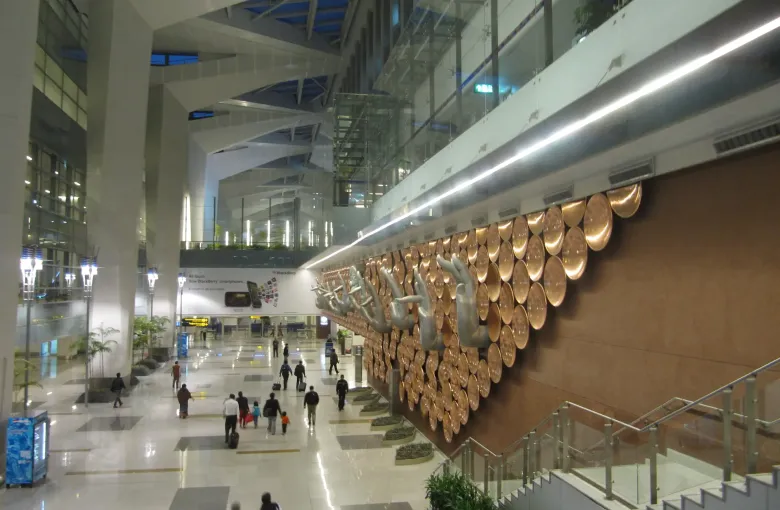
The short version.
India is a country where the transport is part of what you came to see. The railway reaches almost everywhere, domestic flying is cheap and dense, and the road network carries everything the other two do not. Which you use is usually decided by distance rather than preference: a few hundred miles is a train, a thousand is a flight, and the last stretch is almost always a road.
This page covers what the cited sources establish and is honest about the rest. Fares, timetables, booking windows and class names are not in this register, and a page that made them up would be indistinguishable from one that checked.
The railway.
Trains in India are worth taking on their own terms rather than merely as a way of covering ground. The network is old enough to have built the cities it connects, and the stations are among the country's more remarkable buildings: the terminus in Mumbai is itself on the UNESCO World Heritage List, which is a reasonable indication of the scale involved.
The practical points are ordinary ones. Long distance trains book up well ahead, particularly around festivals and school holidays. Overnight services trade a hotel night for a travel day and are the reason a three week itinerary can cover as much as it does. And the fog in northern India in December and January delays them in ways that cascade, which the weather guide in this cluster covers.
Flying.
Domestic aviation is how most visitors cover the long diagonals, and it is the only sensible way to treat a trip that wants both the far north and the deep south in the same fortnight. Nothing in this register carries fares or route maps, so treat that as a planning conversation rather than a research one.
One thing the entry advice does bear on: the exception to the advisory covering the Union Territory of Jammu and Kashmir is travel by air to and from the city of Jammu, and travel within the city of Jammu. That is a transport distinction as much as a geographic one, and the travel safety guide in this cluster sets it out in full.
Driving, and the permit that is not the usual one.
The UK Foreign, Commonwealth and Development Office safety advice states that a 1949 version of the international driving permit is what India recognizes. That is not the version most issuing authorities hand over by default, so it has to be asked for specifically, and a permit of the wrong vintage is no permit at all at a roadside check.
The same advice records that road conditions and driving standards vary, and it names a situation with no equivalent elsewhere: accidents involving cows can draw crowds, and can turn a traffic matter into something more serious very quickly. Most visitors are better served by a driver than by a rental car, and on an organized itinerary that is what we arrange.
Mountains.
The same source records that there are no commercial mountain rescue services operating above 3,000m in India. That is a planning fact rather than a caution: above that line, the rescue you are counting on does not exist in the form you are used to, and the answer is the operator you go with, the insurance you hold and the margin you leave. It is the single strongest argument for going into the high country with people who do it professionally.
Where the road stops.
Parts of India are designated restricted or protected and require a special permit. The entry advice states that the regulations can change at any time and that you should apply 3 months before arrival. In practice this is a transport constraint as much as an administrative one: it decides whether a route exists for you at all. Work backward from it.
Cities.
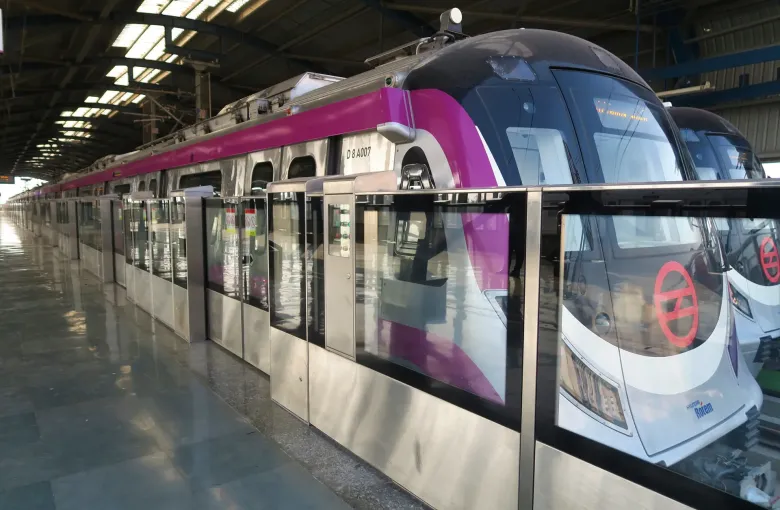
Several Indian cities now run metro systems that are modern, air conditioned and genuinely easy to use, and they sidestep the traffic that otherwise sets the pace of a day. The accessibility guide in this cluster goes into what they do and do not offer a traveler with limited mobility. Above ground, the auto rickshaw remains the workhorse of the short hop, and app based cars have made the fare question much simpler than it used to be.
How to settle it.
Let the distances choose the mode. Book long distance trains early and leave slack in a northern winter. Ask for the 1949 permit specifically if you intend to drive, and consider not driving. And if the itinerary reaches into a restricted area or above 3,000m, raise it with us early, because both change the shape of the trip rather than a detail of it.
Sources
- UK Foreign, Commonwealth and Development Office: gives the police helpline in India as 100 and the national emergency number as 112, with a women helpline on 1091, records that vapes and related products are banned, that possession of illegal drugs carries a minimum sentence of 6 months for small amounts and that you could be detained for several years while your case is processed, that it is illegal to possess and operate satellite phones and GPS devices in India without a license even if you are only transiting through India, that British women have been victims of sexual assault and that travelers should avoid isolated areas including beaches when alone at any time of day, that alcohol is illegal in Bihar, Gujarat, Mizoram, Nagaland and Lakshadweep with a prison sentence of 5 to 10 years and that some states sell 30-day alcohol permits, that a 1949 version of the international driving permit is needed, and that there are no commercial mountain rescue services operating above 3,000m. Accessed 22 September 2026.
- UK Foreign, Commonwealth and Development Office: states that you must have a visa to visit India unless you are an Overseas Citizen of India cardholder, that a passport must be valid for at least 6 months after the date you arrive and have at least 2 blank pages, that an e-arrival card is completed online up to 72 hours before arrival and is not a visa, that accommodation providers must register foreign guests with the Foreigners Regional Registration Office, that a stay of more than 180 days without an OCI card must be registered within 14 days of arrival, that a special exit permit takes between 5 and 15 working days, that amounts above 5,000 US dollars in notes or 10,000 US dollars in notes and travelers checks combined must be declared, and that permits for restricted areas should be applied for 3 months before arrival. Accessed 22 September 2026.
Other Articles
India Travel Safety Guide
Accessible Travel in India