A date to start from
On 3 May 1835, Robert Thompson, sent from the Governor of Jamaica, held court at Pedro St. James and issued the proclamation ending slavery in the British Empire.
For anyone researching Caymanian ancestry that date is a fixed point rather than a commemoration. It marks the boundary the records themselves turn on, and the building where it happened still stands and can be visited.
The sea, and why it scattered people
The Caymanian relationship with the sea is not decorative. It is visible even in the territory own official imagery: a 1950 Cayman Islands postage stamp carries a catboat under sail, captioned as such, the small single masted craft that was the working boat of these islands.
A place that goes to sea for a living sends its people a long way from home, and Caymanian families have connections across the Caribbean, the United States and Britain for that reason. If your family story includes a Caymanian who left, it very often includes a ship.
⚠ What this guide will not claim
It will not tell you that particular surnames are Caymanian, that particular districts hold particular families, or that any genealogical service can trace your line. Those are claims that need archival sources this research did not have, and a page about somebody ancestry is a poor place to guess.
What it can do is point at the institutions that hold the material.
Where to begin
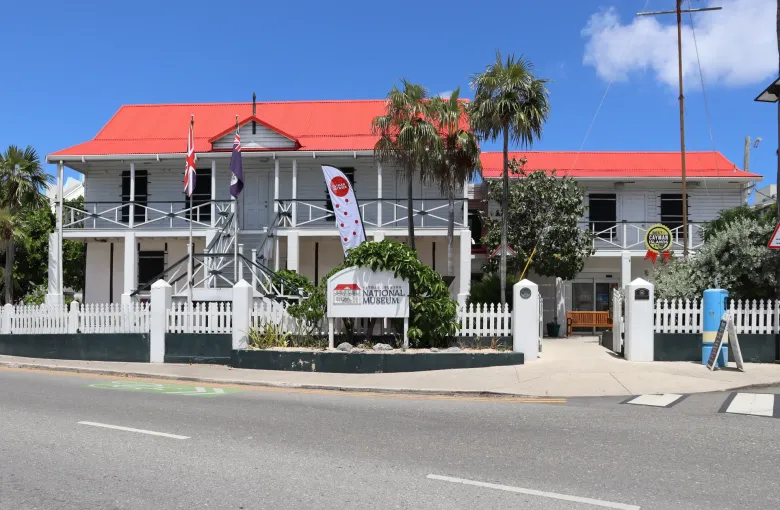
The Cayman Islands National Museum in George Town holds the territory collections and is the natural first approach for documentary history.
The National Trust for the Cayman Islands, established in 1987, preserves the islands built heritage alongside its conservation work, and its historic sites are where the physical record survives. Pedro St. James itself is a national historic site with its own interpretive programs.
Approach all three before you travel rather than on arrival. A small territory of roughly 69,900 people does not have a large archival staff, and a letter sent ahead achieves far more than a walk in.
Practical
- Fix 3 May 1835 in your timeline. It is the boundary the records turn on.
- Write to the National Museum before traveling, not after arriving.
- Visit Pedro St. James for the place itself, and take the interpretive presentation.
- Treat any commercial ancestry claim with the skepticism you would apply anywhere else.
Sources
- Pedro St. James: Site history: the great house built in the late eighteenth century by William Eden using enslaved labor, later used as a courthouse, a jail, a Government Assembly and a restaurant; the meeting of 5 December 1831 at which the decision was made to form the first elected parliament; and the proclamation ending slavery in the British Empire issued there on 3 May 1835 by Robert Thompson, sent from the Governor of Jamaica. Accessed 18 September 2026.
- National Trust for the Cayman Islands: The Trust was established in 1987 as a charity dedicated to protecting biodiversity, local wildlife and critical habitats and to preserving the islands built heritage, and it runs the Heritage Bakehouse as a Caymanian culinary program. Accessed 18 September 2026.
- Ethnologue, SIL International: Cayman Islands country language record: a territory of 69,900 people with no living indigenous languages and two living non-indigenous languages established within it, one of which, English, is also an official language. Accessed 18 September 2026.
Other Articles
Little Cayman Marine Parks: Visitor and Heritage Guide
Cayman Islands Culture and Etiquette Guide