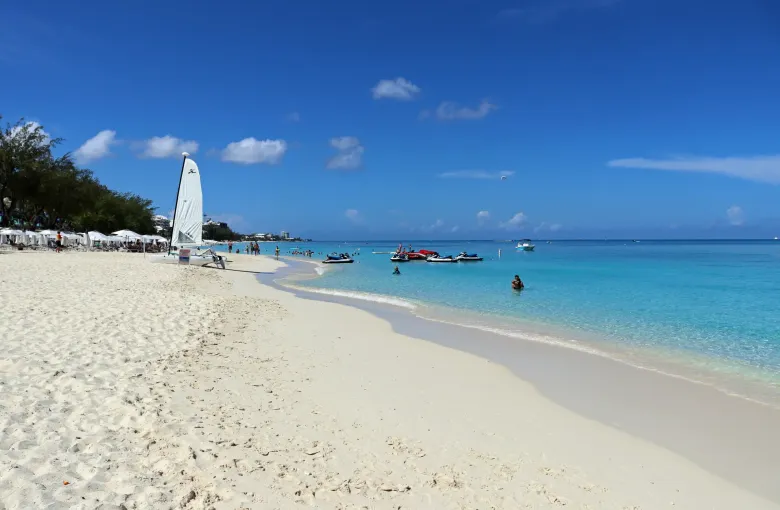
What the Cayman Islands is
The Cayman Islands is a British Overseas Territory. It is not an independent state and it is not a part of any Caribbean nation. It runs its own border, issues its own currency and maintains its own institutions, while remaining under British sovereignty. There is no British Embassy here precisely because the territory own authorities carry out those functions.
Getting that right is the first courtesy. Describing the islands as a country in the sovereign sense, or folding them into a neighbor, misstates something Caymanians are clear about.
Language and scale
The territory is home to around 69,900 people. It has no living indigenous languages, and two living non-indigenous languages are established within it, one of which, English, is also an official language.
Those figures are worth holding together. Seventy thousand people is a small town spread across three islands, and it means the ordinary courtesies of a small place apply: greetings before business, patience in a line, and the working assumption that the person you are speaking to knows the person you are about to mention.
The institutions that hold the record
Two bodies do most of the work of keeping and presenting Caymanian heritage, and both are open to visitors.
The National Trust for the Cayman Islands was established in 1987 as a charity dedicated to protecting biodiversity, local wildlife and critical habitats, and to preserving the islands built heritage. Its work runs from endemic species conservation to historic sites and a heritage culinary program.
The Cayman Islands National Museum in George Town holds the territory collections. A museum in a place of this size is not a formality; it is where the documentary record actually lives.
⚠ Law a visitor should not misjudge
Two points of law catch visitors more often than any point of etiquette.
The first is drugs. The territory operates a zero tolerance policy on illegal and controlled substances, explicitly including cannabis in every form and THC and CBD derivatives such as gummies, vapes and edibles. Social acceptability elsewhere is irrelevant here.
The second is work. You may not accept work without a permit, and even taking purchase orders on a business trip requires a temporary work permit arranged in advance. The line between a holiday and an unlicensed working visit is drawn more firmly than visitors expect.
Arriving well
- Call it a British Overseas Territory, and do not describe it as an independent nation.
- Treat it as a small community, because at roughly seventy thousand people it is one.
- Visit the National Museum or a National Trust site early rather than late; context improves everything after it.
- Carry no controlled substance, and do not conduct business without the right permit.
Sources
- UK Foreign, Commonwealth and Development Office: Cayman Islands travel advice: the record that the Cayman Islands is a British Overseas Territory, that there is no British Embassy, and that the Cayman Islands authorities will support a visitor who needs help. Accessed 18 September 2026.
- Ethnologue, SIL International: Cayman Islands country language record: a territory of 69,900 people with no living indigenous languages and two living non-indigenous languages established within it, one of which, English, is also an official language. Accessed 18 September 2026.
- National Trust for the Cayman Islands: The Trust was established in 1987 as a charity dedicated to protecting biodiversity, local wildlife and critical habitats and to preserving the islands built heritage, and it runs the Heritage Bakehouse as a Caymanian culinary program. Accessed 18 September 2026.
- Cayman Islands Customs & Border Control: Entry requirements: that a visitor must produce a passport or other document establishing identity and nationality valid beyond the date of the return ticket, that it need not be valid for over six months where that exceeds the length of stay, that a paid up return or onward ticket is required, that sufficient funds may have to be shown, that visitors may be granted permission to land for up to six months extendable on application to the Director, and the zero tolerance policy on illegal and controlled substances including THC and CBD derivatives. Accessed 18 September 2026.
Other Articles
The Cayman Islands and Diaspora Reconnection
Cayman Islands Festivals and Celebrations