The useful way to think about this is by who sets the rule. Anything federal, which means air travel, VIA Rail, interprovincial coaches, national parks and federal buildings, works to a single national standard and works reasonably well. Everything else is provincial or municipal, and the answer changes when you cross a boundary.
Flying
Canadian carriers operate under federal accessible transportation regulations. Request assistance when you book rather than at the airport, and confirm it again 48 hours before departure, which is the window airlines work to. Mobility devices travel free and do not count against a baggage allowance.
Two things are worth knowing. A wheelchair should be labeled with your contact details and handling instructions, and photographed before you hand it over, because damage claims are much easier with a photograph. And on smaller regional aircraft, which serve a great many Canadian destinations, cabin and door dimensions can be the limiting factor rather than policy, so ask which aircraft type is scheduled.
Several Canadian airports offer United States preclearance, which is useful: you clear US immigration before boarding rather than on arrival, in a facility built to handle it, and you land in the US as a domestic passenger.
Trains, coaches and cities
VIA Rail carries accessible seating and staff assistance on its corridor services and on the long distance trains, booked in advance. Accessible coach service exists on the main intercity routes and should be confirmed for the specific departure rather than the route.
City transit is where provinces diverge. Toronto, Vancouver, Montreal and Ottawa all run accessible bus fleets and have rail systems at different stages of retrofit, and Montreal's metro in particular has many stations without elevators because it was built long before the requirement. Check station by station rather than system wide. Most cities also run a booked door to door paratransit service, which usually requires registration in advance and sometimes accepts visitors on a temporary basis, so ask early.
National parks and heritage sites
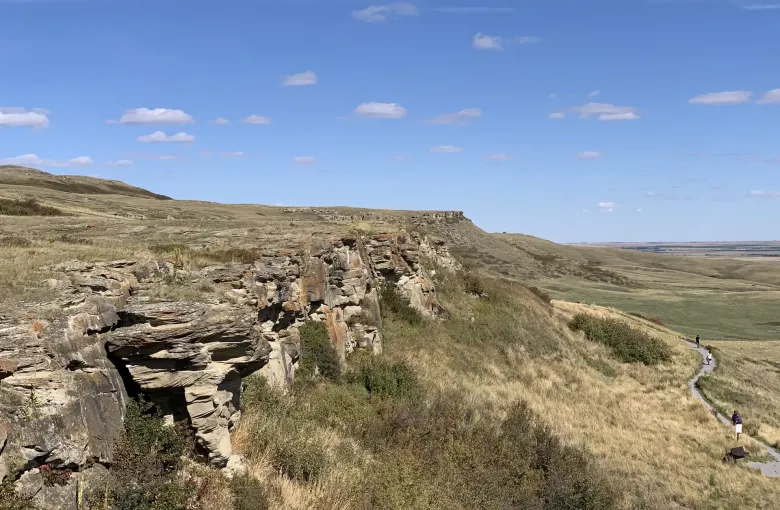
Federal sites are consistently the best provided. Many national parks have accessible viewpoints, boardwalk trails, adapted campsites and beach wheelchairs available at no cost, and the interpretive centers are generally step free throughout. The Head-Smashed-In interpretive building, set into its hillside with elevators between five levels, is a good example of what to expect. Old Quebec is the counterexample: a steep, cobbled World Heritage district where the terrain itself is the barrier, though the funicular between the Upper and Lower Towns helps.
Winter
The season is a genuine accessibility factor here in a way it is not in warmer countries. Snow and ice on sidewalks, curb cuts filled by plowing, and cold that affects some conditions directly all change what is possible between December and March. Many cities have underground or elevated pedestrian networks, Toronto's PATH and Montreal's underground city among them, which are climate controlled, level and genuinely useful.
Before you book
Ask precise questions and ask them of the property rather than the booking site. Roll in shower or tub. Door width in centimeters. Step at the entrance. Elevator to that floor. Bed height. Canadian hotels are generally willing and accurate when asked directly. And carry your own insurance: the FCDO records that treatment in Canada can be very expensive with no special arrangements for visitors, and equipment repair or replacement abroad is exactly what a good policy covers.
Sources
- UK Foreign, Commonwealth and Development Office: Canada health: the record that the emergency medical number is 911 and that a caller should ask for an ambulance, that medical treatment can be very expensive with no special arrangements for British visitors, that travel insurance should cover local treatment and unexpected medical evacuation, and that altitude sickness is a risk in parts of Canada including skiing and hiking destinations in the Canadian Rockies such as Banff and Lake Louise. Accessed 17 September 2026.
Other Articles

Canada for Senior Travelers
Getting Around Canada