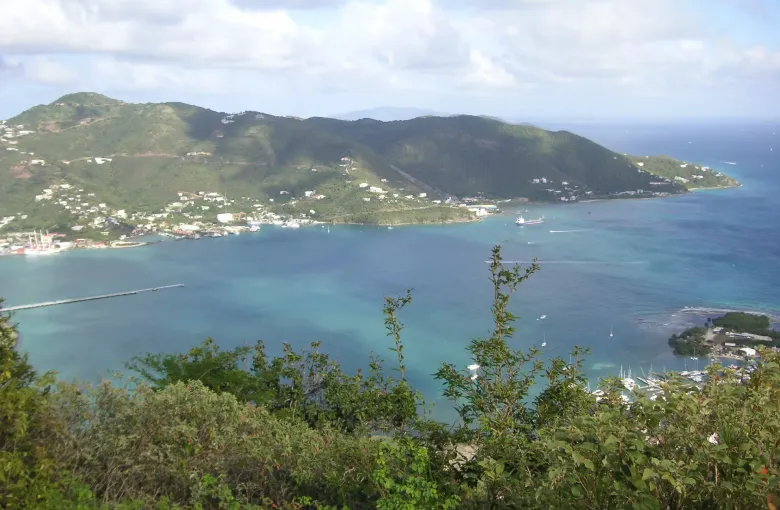
One name, four parks.
The National Park Trust of the Virgin Islands records that The Greater Baths National Park is comprised of The Baths, Devil's Bay, Spring Bay, and Fallen Jerusalem National Parks.
That is worth knowing before you arrive, because most visitors use the name of one of them for all four. The Baths is the part everybody photographs. Devil's Bay and Spring Bay are adjacent and separately designated; Fallen Jerusalem is an uninhabited island offshore. They are protected together and they are not the same place.
The rock, which is the actual heritage here.
The Trust records that the boulders are granodiorite, an intrusive igneous rock similar to granites found on the continents, and that it was formed from the slow cooling of molten rock.
Take that slowly, because it is the point of the site. Most Caribbean islands are volcanic or coral. Intrusive rock forms deep underground, where molten material cools slowly enough for large crystals to grow. Everything you can see at The Baths was once well below the surface, and what stands on the beach today is what remained after everything above it was removed.
The Trust's record for Virgin Gorda describes the result as a collection of massive granite boulders as large as 40 foot in diameter, with white sand beaches and secret rock pools. Forty feet is the figure the territory's own heritage body publishes, and it explains why the site reads as architecture rather than as scenery.
What UNESCO does not say about it.
This is not a World Heritage Site. The United Kingdom States Party record at UNESCO lists the properties of the United Kingdom and its overseas territories, and the Virgin Islands appear nowhere on it, neither inscribed nor on the tentative list. The only overseas territory property on that page from this part of the Atlantic is in Bermuda.
That absence is stated because a reader arriving at a page about a spectacular protected landscape reasonably wonders. The protection here is national, granted by this territory through its own Trust, and that is a complete answer rather than a lesser one.
Visiting, and the rules that apply.
The National Park Trust is responsible for maintaining 21 parks across the territory, of which Virgin Gorda holds six. These are managed protected areas.
The UK Foreign, Commonwealth and Development Office records that it is illegal to remove any marine animal, shells or coral including dead coral, and that fishing is strictly prohibited within the Marine Parks. On a site whose whole character is rock, sand and shallow water, that rule is the one a visitor is most likely to break without meaning to.
The route through the boulders involves ladders, narrow gaps and scrambling over wet rock. It is not a step-free path and it is not suitable for everyone. Our accessibility guide is honest about what that means, and our guide for senior travelers sets out the alternatives.
Where to read the source.
The National Park Trust of the Virgin Islands publishes its own account of the park, and it is the record this page is built from. Everything above is either quoted from it or from the Foreign, Commonwealth and Development Office, and where neither has anything to say, this page does not either.
Sources
- National Park Trust of the Virgin Islands: The Greater Baths National Park: that it is comprised of The Baths, Devil's Bay, Spring Bay and Fallen Jerusalem National Parks, and that the boulders are granodiorite, an intrusive igneous rock similar to granites found on the continents, formed from the slow cooling of molten rock. Accessed 18 September 2026.
- National Park Trust of the Virgin Islands: Virgin Gorda: that the island has 6 national parks, that the site is a collection of massive granite boulders as large as 40 foot in diameter with white sand beaches and secret rock pools, and that Copper Mine Point National Park holds quartz, feldspars, tin, copper and other clay minerals and includes a small fortification and masonry ruins with a munitions store on the hillside. Accessed 18 September 2026.
- National Park Trust of the Virgin Islands: The Trust record that it is responsible for maintaining 21 parks across the territory. Accessed 18 September 2026.
- UNESCO World Heritage Convention: United Kingdom States Party record, which lists the World Heritage properties of the United Kingdom and its overseas territories, among them the Historic Town of St George and Related Fortifications in Bermuda, inscribed in 2000, and on which the Virgin Islands appear nowhere, in the inscribed list or the tentative one. Accessed 18 September 2026.
Other Articles
The Best Time to Visit the British Virgin Islands
What to Pack for the British Virgin Islands