What the geography asks of a visitor.
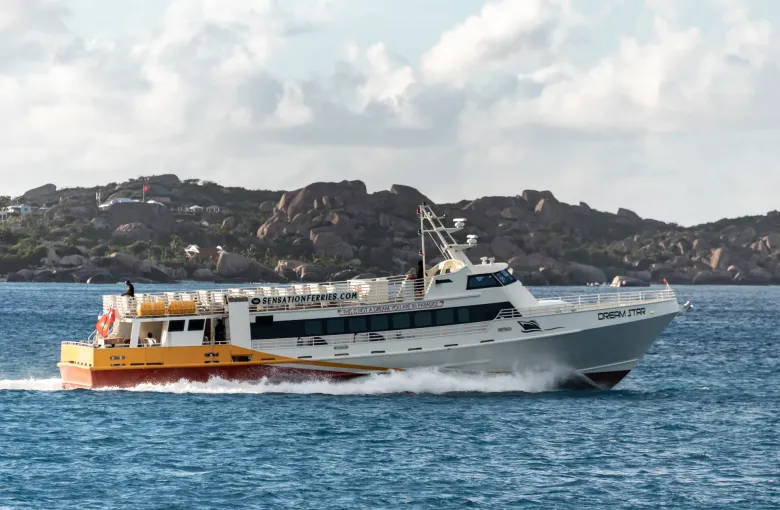
The British Virgin Islands is an archipelago. Moving between islands means boats, and boarding a boat means a dock, a gangway and a step that moves with the water. That is the structural fact of travel here and no amount of planning removes it.
Ashore, the islands are steep. Roads climb, and the National Park Trust of the Virgin Islands describes Virgin Gorda's signature site as a collection of massive granite boulders as large as 40 foot in diameter with secret rock pools. Routes among boulders of that size go between them and beneath them.
The Baths, stated plainly.
The Greater Baths National Park is what most visitors come to see, and the way through it is not a path in the ordinary sense. It is a scramble: narrow gaps between rock, wooden ladders, ropes in places, and surfaces that are wet because the sea comes into them.
This guide says that without softening it. A page that described the site as accessible would send somebody a long way by boat to discover otherwise, and the honest version is more useful than the comfortable one. If the scramble is not possible for you, the park is still worth the trip for the beaches and the water around it, and Devil's Bay and Spring Bay are separately designated parts of the same protected area.
Contact whoever is operating your boat before the day and describe what you need. They know which landings are which, and they will know what is possible in the conditions that week.
The single hospital, and why it matters more here.
The UK Foreign, Commonwealth and Development Office records that there is only one hospital in the BVI, the Dr D. Orlando Smith Hospital, that medical facilities are limited, and that complex problems are often referred to hospitals in the US Virgin Islands, Puerto Rico, or mainland USA.
For a traveler with a condition that may need attention, that is a planning fact rather than a statistic. Bring sufficient medication for the whole trip and a margin, in original labeled packaging with a copy of the prescription, and do not rely on replacing anything locally.
Then read the evacuation section of your insurance. The same record states that a traveler needing medical evacuation to the US mainland who has no US visa will need special arrangements, because the US visa waiver program does not automatically apply on one-off charter flights. That condition applies to everybody, and it deserves attention from anybody whose travel already involves medical planning. Our travel safety guide works through it.
What no source here can tell you.
This guide publishes no list of accessible accommodation, no account of wheelchair provision on ferries, no information about accessible transport and no assessment of any specific venue. No source in its register holds any of it, and the body that might publish it answers every request with the same page.
Invented accessibility information is worse than none, because a traveler will plan around it and arrive to find it untrue. The reliable route is direct contact: ask the specific hotel, the specific ferry operator and the specific charter company, describe exactly what you need, and get the answer from the people who will be there on the day.
One thing in your favor.
A great deal of what is worth doing here happens on the water rather than on foot. A boat with a crew who know what you need can reach a great many places that a steep road and a boulder field cannot, and that is a genuine advantage of this territory rather than a consolation.
Sources
- National Park Trust of the Virgin Islands: The Greater Baths National Park: that it is comprised of The Baths, Devil's Bay, Spring Bay and Fallen Jerusalem National Parks, and that the boulders are granodiorite, an intrusive igneous rock similar to granites found on the continents, formed from the slow cooling of molten rock. Accessed 18 September 2026.
- National Park Trust of the Virgin Islands: Virgin Gorda: that the island has 6 national parks, that the site is a collection of massive granite boulders as large as 40 foot in diameter with white sand beaches and secret rock pools, and that Copper Mine Point National Park holds quartz, feldspars, tin, copper and other clay minerals and includes a small fortification and masonry ruins with a munitions store on the hillside. Accessed 18 September 2026.
- UK Foreign, Commonwealth and Development Office: British Virgin Islands health: the instruction to begin health preparation at least 8 weeks before the trip, the presence of Zika virus and of disease spread by biting insects and ticks, the record that there is only one hospital in the BVI, the Dr D. Orlando Smith Hospital, that medical facilities are limited and that complex problems are often referred to hospitals in the US Virgin Islands, Puerto Rico or mainland USA, and that a traveler needing medical evacuation to the US mainland who has no US visa will need special arrangements because the US visa waiver program does not automatically apply on one-off charter flights. Accessed 18 September 2026.
- UK Foreign, Commonwealth and Development Office: British Virgin Islands safety and security: that levels of crime in the BVI are low while serious incidents including armed robbery and drug-related gun crime do occur, that police and emergency services can be reached at 911, that a passport cannot be renewed or replaced in the BVI, that the BVI is a British Overseas Territory with its own laws, that fishing is strictly prohibited within the Marine Parks and that it is illegal to remove any marine animal, shells or coral including dead coral, that same-sex sexual activity is legal but there is no provision for marriage or civil partnerships between same-sex couples, that you can drive for up to 30 days on a UK license and must then apply for a local one, that the majority of cars are left-hand drive but you drive on the left as in the UK, that the hurricane season in the Caribbean normally runs from June to November, and the work of Virgin Islands Search and Rescue at sea. Accessed 18 September 2026.
Other Articles
The British Virgin Islands for Senior Travelers
Sage Mountain National Park, Tortola