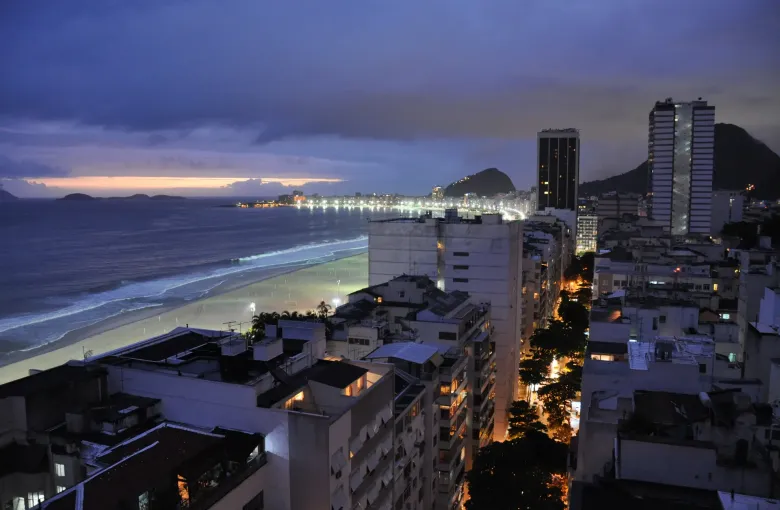
The short version
Carnival moves. It is fixed to Easter, so it falls anywhere from early February to early March. Everything else about planning a February trip to Brazil follows from checking which week it is in the year you are going.
And Carnival is not one festival. Rio's is a ticketed parade in a purpose built stadium. Salvador's is a street festival that takes over a city. Recife and Olinda run a third version again. Choosing between them is the actual decision, not whether to go.
Rio: a parade you watch
The samba school parade runs in the Sambadrome, a purpose built avenue with banked stands, over successive nights, with the winning schools parading again afterwards. It is ticketed, it is formal, it runs through the night, and it is a competition with judges and rules rather than a party that happens to be filmed.
Outside the Sambadrome, Rio also has blocos, the street parties that fill neighborhoods across the city for days on either side. Most visitors who say they went to Carnival in Rio mean the blocos, which are free and enormous.
Salvador: a festival you are inside
Salvador's Carnival is the street one. Trucks carrying bands move along defined circuits through a city whose historic center has been on the World Heritage List since 1985, and the crowd moves with them. It is African in its musical descent in a way Rio's parade is not, and it is the better choice for a visitor who would rather be in something than watch it.
It is also the more demanding of the two: longer on your feet, denser, and harder to leave in a hurry.
What the crowd means for you
The cited safety source is direct about this: criminals target large scale celebrations in Brazil, such as the Carnival in major cities. That is not a reason to skip it. It is a reason to go into it the way people who go every year do.
- Take a photocopy of your passport, not your passport.
- Carry the minimum cash you need and no cards you do not need.
- Keep your phone out of your hand. Phone theft is documented, and the window the source names, four in the afternoon to nine at night, is exactly when a street party fills.
- Agree a meeting point with the people you are with, because phone signal in a Carnival crowd is unreliable and a plan that depends on calling somebody is not a plan.
- Buy and hold your own drinks. Drink spiking is documented, and so is methanol in spirit based drinks.
- Be cautious about a proposal from a stranger that moves you away from a public area.
Festa Junina, the one nobody warns you about
The June festivals are, across much of Brazil and especially in the northeast, a bigger part of the year than Carnival is. Bonfires, quadrilha dancing, corn in every form, and small towns that fill with people who left them. It is warmer in temperament than Carnival and much easier to be a guest at.
New Year on the beach
Reveillon in Rio puts an enormous crowd on Copacabana, dressed in white, with fireworks over the water. It has the same crowd arithmetic as Carnival and the same precautions apply, with one addition that belongs to the beach: the guidance is explicit that you should not go on to city beaches after dark, and a crowd of two million on the sand is a specific exception rather than a general permission.
Religious festivals, and how to be present at one
Many of Brazil's largest gatherings are religious. The Bonfim washing in Salvador and the Cirio de Nazare procession in Belem draw crowds on a scale a visitor is unprepared for, and both are acts of devotion rather than spectacles. Stand at the edge, do not photograph people at prayer without asking, and follow what everybody around you is doing.
Planning around all of it
Flights and accommodation in a Carnival city are booked out and priced accordingly months ahead. If Carnival is the trip, book early. If Carnival is not the trip, check the dates anyway, because arriving in Salvador during it without meaning to is not a neutral experience.
Verify before you travel
Dates move every year and routes, circuits and ticketing change. Confirm the current year's dates and any ticketed event directly with the organizers before you book flights.
Sources
- UK Foreign, Commonwealth & Development Office: Brazil safety and security: the police number 190, favelas and favela tours, robbery on buses and the four in the afternoon to nine at night window for phone theft, arrastoes on beaches, express kidnapping, ATM card cloning and pink marked notes, methanol in spirit drinks, the illegality of vaping devices, shark attacks around Recife, carjacking, taxi and ride hailing practice, and the LGBT+ legal position. Accessed 16 September 2026.
- UNESCO World Heritage Centre: the inscription of the Historic Centre of Salvador de Bahia in 1985 under criteria (iv)(vi), recording the city as the first capital of Brazil from 1549 to 1763 and, from 1558, the first slave market in the New World. Accessed 16 September 2026.
Other Articles
Brazil Culture and Etiquette Guide
Brazil and Diaspora Reconnection