The driving permit is arranged here, not at home.
This is the fact most likely to be got wrong, because the islands nearby do it two other ways and neither is this one. The Government of Barbados states that a visitor or temporary resident of Barbados may obtain a temporary driving permit by applying to The Licensing Authority, at its offices at The Pine in St. Michael, Oistins in Christ Church and Holetown in St. James, or at any approved hired car agency.
You must already hold a valid driving license issued by the traffic authorities in your country of normal residence. The permit is valid for one year or until the expiry of the applicant's driving license, whichever is the shorter time.
The convenience worth noticing is the last clause of the first sentence: an approved hire car agency can issue it, so for most visitors the permit is part of collecting the car rather than a separate errand.
The fee, exactly as the government publishes it.
The published fees are 10.00 for less than two months and 100.00 for two months and over, up to a maximum of one year.
⚠ The government page does not name a currency for either figure. That is not an omission this site is willing to resolve on its behalf, because the same page gives the bus fare explicitly as 3.50 BBD a few lines further down, so the silence is conspicuous rather than obviously accidental. Take the figures as published, expect to pay in local money, and confirm at the counter.
Three kinds of shared transport, told apart by color.
The Government of Barbados names the options as the Barbados Transport Board, Public Service Vehicles, Route Taxis or ZRs, and taxi cabs. The useful part is that it describes the private ones by how they look, which is how you will actually identify them at a roadside:
- Transport Board buses, the government service, with published schedules.
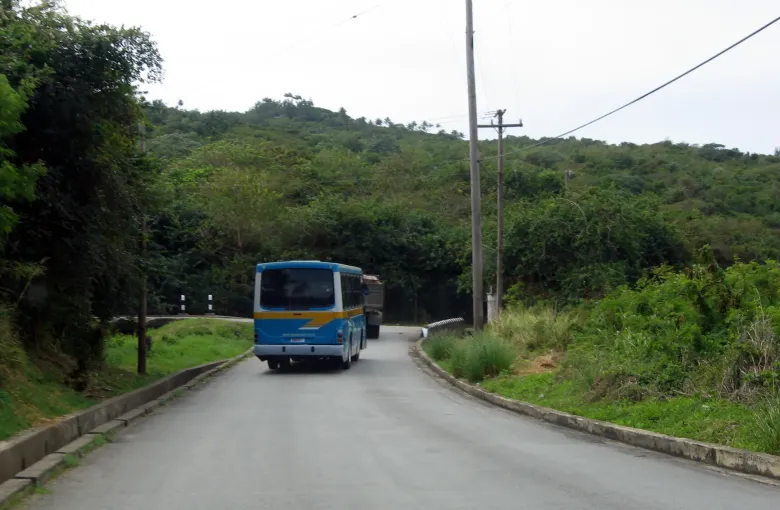
- Minibuses, painted bright yellow with a blue stripe. They are privately owned and travel select routes, and the destination is usually displayed in the bottom left corner of the windshield, which is worth checking because they do not all go where you assume. The fare is the same 3.50 BBD as the transport board buses.
- Route Taxis, known as ZRs, white minivans with a maroon stripe down the side and the letters ZR on the license plate, running specific routes numbered one through eleven.
The government page gives no fare for the ZR vans, so none is published here.
Taxis: agree the fare, in Barbados dollars, before you get in.
Both sources agree and both are worth having. The Government of Barbados states that taxis do not operate on a meter system, that it is imperative to establish a fare before accepting a ride, and that the fares are regulated by the government. The Foreign, Commonwealth and Development Office adds that there are standard fares for most destinations, that you should agree the fare in Barbados dollars with the driver, and that drivers do not always accept card payments, so carry cash.
Read together, that is not a warning about being overcharged so much as an instruction about how the system works: prices are set, and confirming one is the normal opening move. The official safety advice separately asks visitors to only use licensed taxis. Many drivers also offer island tours at a flat rate, which the government page notes directly.
Our money guide explains why the cash rule matters more here than in most places, and our travel safety guide covers road conditions.
Sources
- Government of Barbados: Getting Around Barbados: that a visitor or temporary resident may obtain a temporary driving permit by applying to the Licensing Authority offices at The Pine in St. Michael, Oistins in Christ Church and Holetown in St. James, or at any approved hired car agency; that the applicant must hold a valid driving license issued by the traffic authorities in their country of normal residence; that there is a fee for the permit and that it is valid for one year or until the expiry of the applicant driving license, whichever is the shorter time; that the visitors permit costs 10.00 for less than two months and 100.00 for two months and over up to a maximum of one year, with no currency named; that the transportation used for getting around is the Barbados Transport Board, Public Service Vehicles, Route Taxis or ZRs and taxi cabs; that the minibuses are painted bright yellow with a blue stripe, are privately owned and travel select routes, and that their fare is the same 3.50 BBD as the transport board buses; that ZR vans are white minivans with a maroon stripe down the side and the letters ZR on the license plate and run specific routes numbered one through eleven; and that taxis do not operate on a meter system, that a fare should be established before accepting a ride, and that fares are regulated by the government. Accessed 20 September 2026.
- UK Foreign, Commonwealth and Development Office: Barbados travel advice, safety and security: that although there is no recent history of terrorism in Barbados attacks cannot be ruled out; that there have been incidents of violent crime including armed robbery, sexual assault, gang-related shootings and carjackings, and that there has been an increase in gang-related murders involving guns, some in populated and public areas; that visitors should secure their accommodation, take care walking alone off busy main roads and taking money from ATMs, avoid isolated areas including beaches after dark, use only licensed taxis, take particular care around large gatherings including street and beach parties, and leave valuables in a safe; that it is illegal to possess drugs and that there are severe penalties for all drug offenses; that it is illegal for anyone, including children, to wear camouflage clothing; that attitudes toward the LGBT+ community in the Caribbean are mostly conservative; that currents can be deceptively strong including on some popular beaches on the south and west coasts and that some beaches have no lifeguards or warning flags; that taxis do not have meters, that there are standard fares for most destinations, that the fare should be agreed in Barbados dollars with the driver, and that drivers do not always accept card payments; that the hurricane season normally runs from June to November; that earthquakes are a potential risk with occasional tremors; and that the underwater volcano Kick em Jenny is located 5 miles off the coast of Grenada. Accessed 20 September 2026.
Other Articles
Barbados Travel Safety Guide
The Best Time to Visit Barbados