The short version
Austrian food is the cooking of an empire that reached into Italy, Hungary, Bohemia, Poland and the Balkans, and it never gave the borrowings back. That is why a Viennese menu reads like a map of central Europe, and why arguing about where any individual dish came from is a national pastime rather than a settled question.
We publish no prices on this page. Prices move and a figure printed here would mislead somebody next season.
Wiener Schnitzel, and what it actually is
The dish everybody comes for is worth being precise about. A Wiener Schnitzel is veal, pounded thin, breaded and fried so that the coating puffs away from the meat. If it is pork it is not a Wiener Schnitzel and a proper Austrian menu will say so, usually as Schnitzel vom Schwein. Both are good; they are not the same thing, and the price difference tells you which you are being offered.
It comes with potatoes and a lemon wedge, and often with lingonberry preserve, which sounds wrong and is not.
The rest of the canon
- Tafelspitz, boiled beef served in its broth with horseradish and apple sauce. The emperor's dish, and a better test of a kitchen than schnitzel.
- Gulasch, brought from Hungary and made heavier and darker on the way.
- Käsespätzle, the cheese noodles of the alpine west, which is mountain food and tastes like it.
- Knödel, dumplings, sweet or savoury, which appear in soup, beside meat and as a dessert with apricots inside them.
- Apfelstrudel and Sachertorte, the two pastries visitors can name, and Kaiserschmarrn, shredded pancake with fruit compote, which is the one they should.
The coffee house, which is not a café
The Viennese coffee house is a recognized cultural tradition and it has rules, none of them written down. You order a coffee and you are entitled to the table for as long as you want it, with a newspaper and no pressure to order again. Nobody will hurry you and nobody will befriend you.
Order by name rather than by description, because the names are specific and the staff will ask if you are vague. A Melange is the closest thing to what most visitors mean by coffee. A Kleiner Brauner is a small black coffee with cream on the side. An Einspänner comes in a glass under whipped cream. A glass of water arrives alongside whatever you asked for, uninvited, and that is correct.
Eating at the market
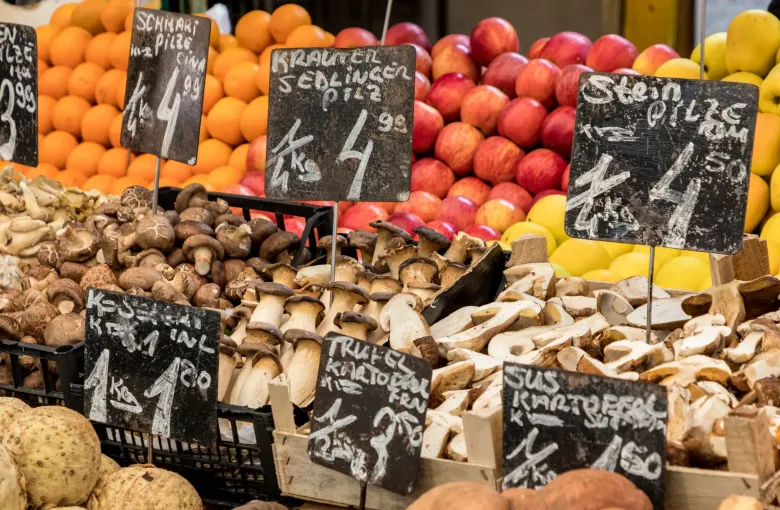
Vienna's Naschmarkt is the obvious one and it rewards going hungry rather than going to shop. The stalls sell produce, cheese, cured meat, pickles and spices, and the stands between them sell lunch. Prices are chalked up in German; reading the sign before you point at something is the difference between a market and a tourist trap.
The rule that applies at any Austrian market: if a stall is busy with people who are obviously local and shopping rather than photographing, eat there.
Wine, beer and what to ask for
Austria is a serious wine country and a badly understood one. The white grape to ask for is Grüner Veltliner, which is grown almost nowhere else and is the default carafe in a Viennese wine tavern; the red is Blaufränkisch. The taverns themselves, Heuriger in the east, serve the current year's wine at long tables with cold food, and the good ones are in the villages on the edge of Vienna rather than in the center.
Beer is brewed everywhere and drunk by the half liter. In the alpine west, schnapps made from fruit is offered after a meal and refusing is entirely acceptable.
Dietary requirements, honestly
Austrian cooking is built on meat, dairy and wheat, and the traditional canon has very little in it for a vegan or a coeliac. The cities have solved this and the villages largely have not. If somebody in your group has a serious dietary restriction, have it communicated in German in advance rather than negotiated at the table, and expect a mountain hut to have fewer options than a Vienna restaurant.
Verify Before You Travel
- Your tour operator or guide, for restaurant bookings and for dietary requirements passed on in German before you arrive.
- The market's own opening days, because Austrian markets close on Sundays and some close on Monday too.
Sources
- UK Foreign, Commonwealth & Development Office: Austria travel advice: no advisory against travel to any part of the country. Accessed 16 September 2026.
Other Articles
Austria Culture and Etiquette
Austria Festivals and Events