What this page is, and what it is not.
Aboriginal and Torres Strait Islander peoples have lived on this continent continuously for tens of thousands of years. They are not a diaspora, they were not dispersed from anywhere else, and a visitor coming here is not reconnecting with anything. This page exists because the framework behind this cluster has a slot for heritage and community, and on Australia the honest subject of that slot is living cultures on their own land and how a visitor should behave on it.
Almost everything below comes from Parks Australia's pages for Uluṟu-Kata Tjuṯa National Park, which are written in the first person by the park's Traditional Owners. Where this page can cite them it does, and where it cannot it says so rather than filling the gap.
Whose voice the sources are in.
The park's own pages state: we are Yankunytjatjara and Pitjantjatjara people, the traditional landowners of Uluṟu-Kata Tjuṯa National Park. They state that they speak their own language and teach it to their children, and that in that language they call themselves Aṉangu and ask visitors to use that word too.
That last sentence is a request made by the people entitled to make it, and this cluster uses the word and the spellings the park uses. The consonants written with a line beneath them are part of the writing system for the language, not decoration, and they are reproduced rather than flattened for the same reason a place name anywhere else is.
Parks Australia names Tjukurpa as the foundation of Aṉangu life: law, knowledge, and the relationships between people, plants, animals and the land. It is not a story told to visitors, and this page does not attempt to summarize it. What a visitor needs to take from it is that the restrictions in the park are an expression of it.
What the park asks of you.
These are Parks Australia's requests, in its own terms.
- Greet people by saying palya, which is how Aṉangu traditionally greet each other.
- Use kinship terms rather than personal names.
- Do not enter or photograph restricted areas, including sacred sites, ceremonial sites and burial grounds. These are signed.
- Always ask for permission before photographing Aṉangu.
- Stay on marked tracks and paths.
- Obtain a permit for any image you want to use for commercial purposes.
The last one catches more visitors than the others, because the line between a holiday photograph and a commercial one has moved. If images from your trip will appear anywhere that earns money, including a monetized account or a business page, that is the permit conversation and it is better had before the trip than after it.
The climb, as an illustration of all of it.
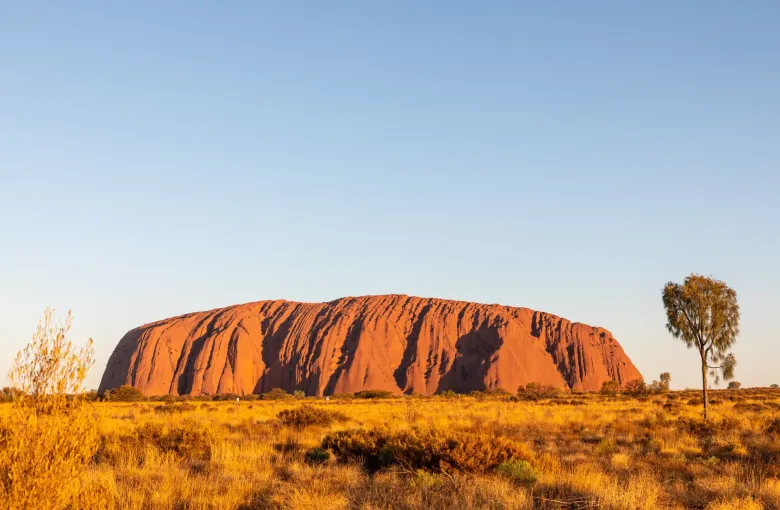
Parks Australia records that the Uluṟu climb closed permanently from 26 October 2019, timed to the 34th anniversary of Handback, the day the park was returned to its Traditional Owners. It records that Uluṟu has been sacred to Aṉangu for tens of thousands of years, that the proportion of visitors climbing had been falling below 20%, and that climbing after the closure is a breach of the Environment Protection and Biodiversity Conservation regulations for which penalties will be issued.
The useful part of that history for a visitor is the order of events. The request not to climb was made for decades and was published at the base of the rock for years before the closure. The closure followed the request rather than replacing it. Where a sign in Australia asks rather than instructs, the asking is the point.
Heritage recognized at the highest level.
Parks Australia records that Uluṟu-Kata Tjuṯa is dual listed on the UNESCO World Heritage List for its outstanding natural and cultural values, which very few properties anywhere carry. The UNESCO World Heritage Centre record for Australia lists 21 inscribed properties, of which Cultural 5, Natural 12 and Mixed 4, and among them are the Budj Bim Cultural Landscape, an Aboriginal aquaculture system in Victoria, and the Murujuga Cultural Landscape, inscribed in 2025 and holding one of the largest concentrations of rock art in the world.
Those two are named here because they are on the published list, and because they are evidence against the idea that this continent's Aboriginal heritage is only in its center.
What this page cannot tell you.
There are hundreds of Aboriginal and Torres Strait Islander nations, each with its own language, law and Country, and this cluster's research register reaches the published material of exactly one national park. Nothing here should be read as applying to a different nation on different Country. Protocols differ, the appropriate words differ, and the right people to ask differ.
The general principle that does travel is the one the park states: ask, and do not assume. Where an experience is offered by an Aboriginal or Torres Strait Islander owned business or guide, that is the version worth booking, both because the account will be first hand and because the money stays where it should. Tell us if that matters to your trip and we will build it that way.
Sources
- Parks Australia, Uluṟu-Kata Tjuṯa National Park: asks visitors to greet people by saying palya, to use kinship terms rather than personal names, not to enter or photograph restricted areas including sacred sites, ceremonial sites and burial grounds, always to ask permission before photographing Aṉangu, to stay on marked tracks and paths, and to obtain a permit for any image you want to use for commercial purposes. Accessed 22 September 2026.
- Parks Australia, Uluṟu-Kata Tjuṯa National Park: states in the words of the Traditional Owners that they are Yankunytjatjara and Pitjantjatjara people, the traditional landowners of Uluṟu-Kata Tjuṯa National Park, that in their own language they call themselves Aṉangu and ask visitors to use that word, that Tjukurpa is the foundation of Aṉangu life, and that the park is dual-listed on the UNESCO World Heritage List for its outstanding natural and cultural values. Accessed 22 September 2026.
- UNESCO World Heritage Centre: records 21 properties inscribed on the World Heritage List for Australia, of which Cultural 5, Natural 12 and Mixed 4, and 8 sites on the Tentative List, and lists the Great Barrier Reef, the Budj Bim Cultural Landscape and the Murujuga Cultural Landscape among the inscribed properties. Accessed 22 September 2026.
- Parks Australia, Uluṟu-Kata Tjuṯa National Park: records that the Uluṟu climb closed permanently from 26 October 2019, timed to the 34th anniversary of Handback when the park was handed back to the Traditional Owners, that Uluṟu has been sacred to Aṉangu for tens of thousands of years, that climber numbers had been falling below 20% of visitors, and that climbing is now a breach of the Environment Protection and Biodiversity Conservation regulations for which penalties will be issued. Accessed 22 September 2026.
Other Articles
Uluṟu-Kata Tjuṯa National Park

Culture and Etiquette in Australia