The currency, and what this page can and cannot give you.
Thailand's currency is the Thai baht. This guide gives no exchange rate, no daily budget and no typical price, because no source in this cluster publishes them and any of the three would be out of date by the time you read it. What it gives instead are the baht figures that appear in official guidance, which are worth knowing precisely because they are enforced.
The money you may be asked to show at the border.
The UK Foreign, Commonwealth and Development Office records that a traveler entering Thailand may be asked to show funds of at least 10,000 Thai baht per person, or 20,000 per family, together with evidence of onward or return travel. It adds that British nationals have been refused entry for failing to provide that evidence.
Two practical notes follow. This is a requirement about evidence rather than about cash in hand, and the second half of it, the onward travel, is the half people forget. The entry requirements guide sets out the full passage and whose rule it is.
The other official baht figures are fines.
The same source sets out the penalty for overstaying a permitted stay: 500 Thai baht a day, to a maximum of 20,000 baht, alongside detention, deportation at the traveler's own expense and a re-entry ban of up to 10 years. It is the largest baht figure this cluster can cite, and it is not one anybody plans to spend.
It is worth reading against the 30-day visa-exemption allowance in force since 15 September 2026, because the two together define what an unextended tourist trip costs if it runs long.
ATMs, and the one specific warning the source gives.
The FCDO states that there have been incidents of ATM skimming in Thailand, and advises using an ATM in a bank and always protecting your PIN. It also notes card fraud, and says not to lose sight of your card during a transaction.
That is unusually specific advice and it is easy to act on: choose the machine inside or attached to a bank branch rather than a free-standing one, and keep the card in view when you pay. The travel safety guide places it alongside the other warnings from the same page.
What is normal to encounter, stated carefully.
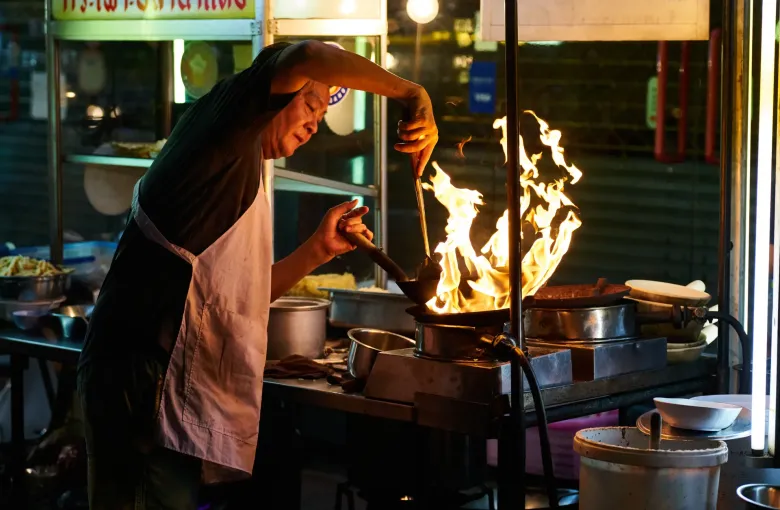
Cash is widely used in markets and at street stalls, and Thailand also has a well-established domestic QR payment system that you will see advertised at stalls and counters. This guide does not describe how to use the latter as a visitor, because whether a foreign-issued card or a foreign phone can access it is exactly the kind of detail that changes and that no source here can confirm. Ask your own bank before you rely on it.
Carry enough cash to be independent of a card that might not work, and treat any advice about Thai payment apps, including this paragraph, as something to verify rather than something to plan around.
Where a figure is missing, that is deliberate.
If you want a budget, that is a real question and it deserves a real answer rather than an invented one. We will build it against your actual itinerary, region by region, and tell you which parts are quoted and which are estimates.
Sources
- UK Foreign, Commonwealth and Development Office: the Thailand entry requirements page, which describes the rules Thailand applies and writes them for people traveling on a full British citizen passport, so the framing is the British position rather than a general one: that a passport must have an expiry date at least 6 months after the date of arrival and at least 1 blank page; that from 1 May 2025 all foreign nationals entering Thailand, whether by air, land or sea, must complete a digital arrival card online before arrival, and that it can be registered within 3 days before arrival; that from 15 September 2026 entry under the visa exemption scheme allows a stay of up to 30 days for tourism only, and that visa-exempt entry does not cover business travel including conferences and meetings; that a traveler may be asked to show funds of at least 10,000 Thai baht per person or 20,000 per family together with evidence of onward or return travel, and that British nationals have been refused entry for failing to provide it; and that overstaying carries a fine of 500 Thai baht a day up to a maximum of 20,000 baht, with detention, deportation at the traveler own expense and a ban from re-entering Thailand for up to 10 years, adding that conditions in detention centers can be harsh. Accessed 22 September 2026.
- UK Foreign, Commonwealth and Development Office: the Thailand safety and security page: that criticizing the Thai monarchy is illegal, that the law can be interpreted broadly and carries a long prison sentence, and that journalists, human rights defenders and members of the public have faced charges over political comments and shared articles; that travelers should not hand a passport over as a guarantee, for example to motorcycle or jet-ski rental businesses, because companies may hold on to passports against claimed damage; that people have arrived in Thailand and been illegally transported to neighboring countries on the promise of high-paying jobs that turn out to be scams, and may then be detained on re-entry while their immigration status is validated; that drink spiking and drug-assisted sexual assault happen in tourist areas with both male and female victims, that attacks are most common during full moon parties or similar events and near bars late at night, and that drinks served in bars are often stronger than those at home; that there have been incidents of ATM skimming and that a traveler should use an ATM in a bank and protect the PIN; and that people have drowned in strong riptides, that Thailand has lifeguards at designated beaches and operates a flag system for safe swimming, and that warning signs and especially red flags should be followed. Accessed 22 September 2026.
Other Articles
Thailand Visa and Entry Requirements
Thailand Travel Safety Guide