The first thing to understand.
Singapore has four official languages and no single majority religion, and it was built deliberately on the premise that those communities live alongside each other rather than separately. That is not a piece of background color; it is the thing that explains most of what follows, from the public holidays to the food to the unusual firmness of the rules about how people behave toward one another in public.
Language, and how much English does.
English is a working language of government, business and education, and a visitor will be understood almost everywhere. Mandarin, Malay and Tamil are the other official languages, and Malay is the national language. Colloquial Singapore English borrows from all of them, which is why a conversation can be completely comprehensible and still contain words you have never heard. Asking what one means is welcomed rather than awkward.
Greetings and names.
A handshake is normal in business and increasingly in ordinary introductions. Some Muslim and some older Chinese Singaporeans prefer not to shake hands with someone of the opposite sex, so take the cue offered rather than extending a hand first and let the other person set it. Names follow several different conventions here, so the safe move is to ask what someone would like to be called rather than guessing which part of a name is the family name.
Visiting places of worship.
Mosques, Hindu and Buddhist temples, and churches are among the most interesting buildings in this city, and most welcome respectful visitors. Cover shoulders and knees. Remove shoes where the sign or the shoe rack says to, which is at most temples and all mosques. Ask before photographing people, and do not photograph anyone at prayer. Many mosques lend a robe at the door, and many temples post visiting hours that exclude the times of service.
Several of the best known sit in the historic quarters, and one rule travels with two of those names. The UK Foreign, Commonwealth and Development Office safety advice records that drinking in a public place is illegal between 10:30pm and 7am, and names Geylang and Little India as Liquor Control Zones where public drinking is banned at weekends and on public holidays. That is a legal rule rather than an etiquette one, and it is worth knowing before an evening in either.
Where manners end and law begins.
This is the part that distinguishes Singapore. A good deal of what a visitor would file under politeness is codified. The same safety advice records an on-the-spot fine for littering, that Orchard Road is a designated no smoking zone, that vandalism including graffiti can be punished by caning, and that outrage of modesty, which covers unwanted physical contact, carries penalties including caning. Eating and drinking on the trains is not permitted.
None of that is enforced against visitors in a punitive spirit, and all of it is enforced. The useful mental model is that the informal tolerances of most cities are formal rules here, and that the rules are published rather than improvised.
At the table.
Hawker centers have their own etiquette, covered in this cluster's food guide, and the two things that matter most are securing a table before ordering and returning your tray afterward. In a Chinese restaurant, communal dishes are shared and serving others before yourself is a courtesy. In a Malay or Indian setting, the right hand is used for eating and passing. Tipping is not the custom, and many restaurants add a service charge to the bill instead.
Photography, conversation and the public realm.
Photograph buildings freely and people with permission. Singaporeans are generally direct and unbothered by questions about their city, and questions about race and religion are handled with more care here than a visitor may expect, for reasons that go back to the country's founding. Take the tone from the person you are speaking to.
One place that rewards the effort.
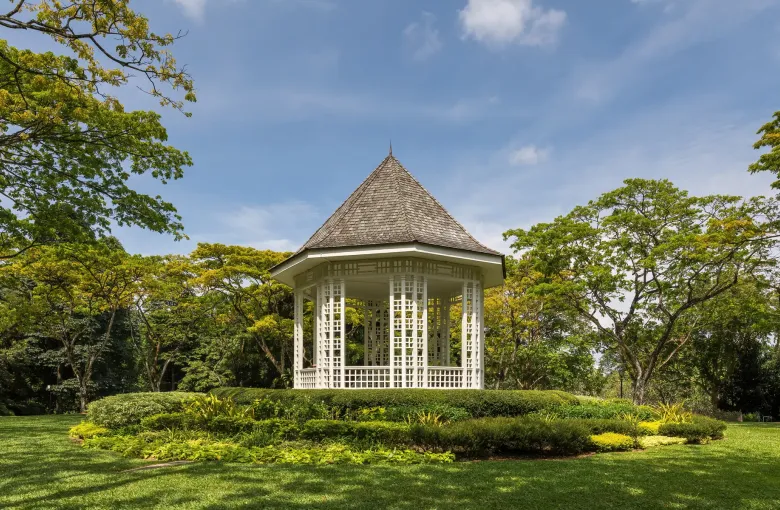
The UNESCO record lists one property inscribed on the World Heritage List for Singapore, the Singapore Botanic Gardens, inscribed in 2015. It is a working public park as much as a monument, which means the etiquette there is ordinary park etiquette practiced by a city that takes its public spaces seriously. Go early. The heritage guide covers what the record establishes.
Sources
- UK Foreign, Commonwealth and Development Office: records that violent crime and theft are rare in Singapore, that there are severe penalties for all drug offenses including when transiting through the airport, that foreigners who are not permanent residents are prohibited from attending outdoor demonstrations and that filming an illegal gathering is forbidden, and that drinking in a public place is illegal between 10:30pm and 7am with Liquor Control Zones where it is banned at weekends and on public holidays. Accessed 22 September 2026.
- UNESCO World Heritage Centre: records one property inscribed on the World Heritage List for Singapore, the Singapore Botanic Gardens, inscribed in 2015 as a cultural property, and one site on the Tentative List, the Padang Civic Ensemble. Accessed 22 September 2026.
Other Articles
Singapore Heritage and Community Guide
Singapore Festivals and Celebrations