The short version.
Singapore is among the easier cities anywhere to move around with a wheelchair, a walking aid, a stroller or reduced stamina. The rail network is step-free with lifts at stations, the public buses are wheelchair accessible, and much of the city center is linked by covered, level walkways and underground passages. That last point is the one that matters most here, because the barrier in this climate is as often heat as it is a step.
What this page cannot give you is a station-by-station audit. No source in this cluster research register publishes one, and an out-of-date access claim is worse than none. The Land Transport Authority publishes the current position on the rail and bus networks, and two local bodies hold the wider picture: the National Council of Social Service, and Disabled People Association Singapore, which is this country advocacy organization on the subject.
Rail and buses.
Lifts serve the platforms, gaps are small and level boarding is the norm rather than the exception. Priority seating and priority boarding are signed and generally respected. Buses have ramps and a wheelchair space, and the driver deploys the ramp on request. Two practical qualifications: interchange stations are very large, so a transfer can be a long push even when it is entirely step-free, and the network is extremely busy at peak times.
Eating and drinking are not permitted on the trains, which matters for anyone who needs to take medication or manage blood sugar on a journey, and it is worth planning around rather than being caught by.
Taxis and ride-hailing.
Wheelchair accessible taxis exist and are booked in advance rather than hailed. Standard taxis and ride-hailing cars are plentiful, and for a traveler who can transfer to a seat they are the simplest way to shorten a hot day. Build in extra time for an accessible booking at peak hours.
The heat is an accessibility question here.
This is the part visitors underestimate. Constant high humidity reduces stamina for everyone and does so disproportionately for anyone with a cardiac or respiratory condition, anyone self-propelling a wheelchair, and anyone whose medication affects heat tolerance. Plan around it: outdoor ground early, indoor ground in the middle of the day, and the covered and underground routes rather than the direct line on a map.
The UK Foreign, Commonwealth and Development Office health advice records that from June to October Singapore can experience high levels of pollution, and names the Pollutant Standards Index as where to check the current reading. For anyone with a respiratory condition that is the single most useful thing to look at before planning a day outdoors.
The Botanic Gardens, and the heritage quarters.
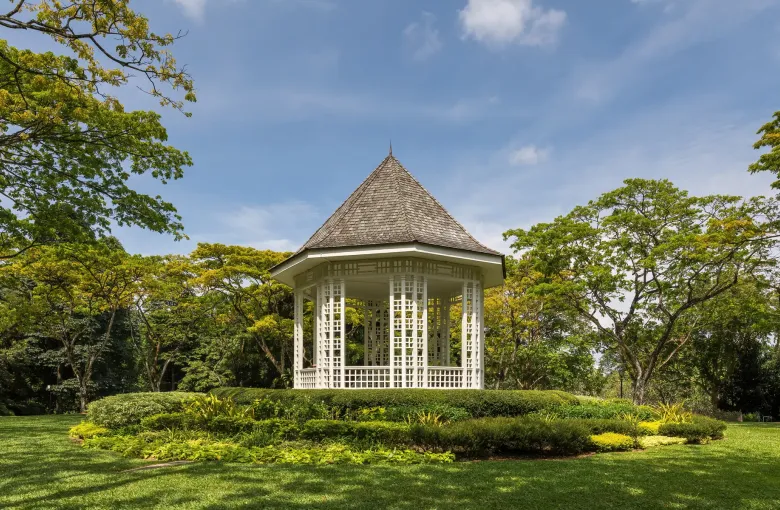
The UNESCO record lists one property inscribed on the World Heritage List for Singapore, the Singapore Botanic Gardens. Much of it is level with good surfaced paths, and its several gates mean you can start near what you want to see rather than crossing the whole site. It is the easiest major attraction here to visit with limited mobility, and it is free.
The historic shophouse quarters are the harder ground, and honestly so. Five-foot ways, the covered walkways in front of the shophouses, are narrow, uneven, and frequently interrupted by steps between one building and the next, because the buildings were built individually. Some streets are manageable and some are not, and it varies block by block. The main roads beside them are level and crossable, so a visit is usually possible; a continuous route along the frontages often is not.
Museums, attractions and toilets.
The national museums and the major attractions are modern buildings and are generally well provided for, with lifts, accessible toilets and, at several, loan wheelchairs. Accessible toilets are common in malls, museums and transport hubs, which is one of the practical advantages of a city organized around indoor space.
Planning notes.
Contact hotels directly about the specifics rather than relying on a booking site category, and ask about the bathroom rather than the room. Bring your own equipment if you rely on it, since hire is possible but limited. Carry medication in original labeled packaging with the prescription, and check it against Singapore's rules on controlled medicines before you travel. And build shorter days than you would at home, because the constraint here is the climate rather than the infrastructure.
Sources
- UK Foreign, Commonwealth and Development Office: advises seeking advice at least 8 weeks before a trip, records Zika virus, dengue and chikungunya in Singapore and that hand, foot and mouth disease is common there, states that from June to October Singapore can experience high levels of pollution, and gives the Pollutant Standards Index as the place to check it. Accessed 22 September 2026.
- UNESCO World Heritage Centre: records one property inscribed on the World Heritage List for Singapore, the Singapore Botanic Gardens, inscribed in 2015 as a cultural property, and one site on the Tentative List, the Padang Civic Ensemble. Accessed 22 September 2026.
Other Articles
Singapore for Senior Travelers
Getting Around Singapore