The history is real, and it is regional before it is local.
The Caribbean coast of Central America carries one of the more significant African diaspora histories in the Americas, and Honduras sits in the middle of it. The Garifuna, descended from West and Central African people and the Indigenous Carib and Arawak of the eastern Caribbean, are present along this coastline, and their language, dance and music are inscribed on UNESCO's Representative List of the Intangible Cultural Heritage of Humanity jointly for Belize, Guatemala, Honduras and Nicaragua.
That inscription is held jointly by Belize, Guatemala, Honduras and Nicaragua. It is not Honduras's alone and it is emphatically not one island's. A page that presents it as a Roatan asset has taken something shared by four countries and a people spread across them, and attached it to a cruise port.
The UNESCO record itself describes a language of the Arawakan group that has survived centuries of discrimination and linguistic domination, rich in tales originally recited at wakes and large gatherings, with melodies bringing together African and Amerindian elements and texts that hold the history and traditional knowledge of the Garifuna.
What this page cannot tell you, and will not imply.
The UNESCO record for the Garifuna element does not mention Roatan anywhere. None of the nine sources in this cluster's register describes a community, a site or an observance on this island in terms that could be cited here. That is a limit of this register rather than a statement about the island, and the honest response is to name it rather than to fill it.
So this page does not tell you where to go on Roatan to meet that history, because it has no sourced basis to send you anywhere, and a diaspora page that invents a destination is doing something worse than a food page that invents a restaurant.
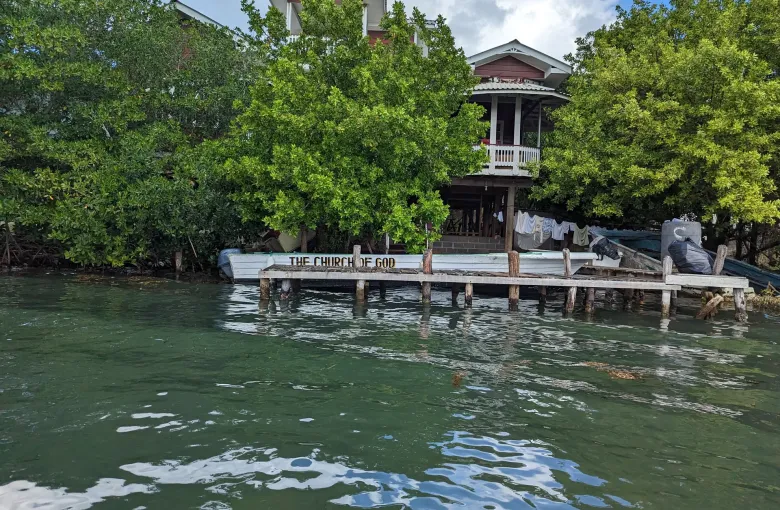
The imagery on this page is the island from the air for the same reason. There is no photograph of a Garifuna community on Roatan available to this cluster under a usable license, and the alternatives found were from Belize and from the Honduran mainland. Using one of those here, on a site that also publishes a Belize cluster carrying the same shared inscription, would have looked like corroboration and been a fabrication.
What is honestly on offer.
A visit made for this reason deserves preparation rather than a shore excursion. That means reading before you travel, contacting cultural organizations directly, and treating a few hours between docking and all-aboard as an introduction rather than a reconnection.
The culture and etiquette guide covers how to be in the island's settlements as a visitor, and it applies here with more weight than usual: these are communities, not sites.
If this is why you are going, tell us that, and the trip can be built for it rather than around a ship's schedule. It is the kind of journey that repays a longer stay and local contacts made in advance, and it is not one this page will pretend a port call delivers.
Sources
- UNESCO Intangible Cultural Heritage: the Representative List entry for the language, dance and music of the Garifuna: that it is inscribed jointly for Belize, Guatemala, Honduras and Nicaragua; that the Garifuna language belongs to the Arawakan group of languages and has survived centuries of discrimination and linguistic domination; and that the melodies bring together African and Amerindian elements, with texts that hold the history and traditional knowledge of the Garifuna. The entry does not mention Roatan. Accessed 21 September 2026.
- UNESCO World Heritage Centre: the Honduras State Party record: that Honduras has two properties inscribed on the World Heritage List, the Maya Site of Copan inscribed in 1980 as a cultural property and the Rio Platano Biosphere Reserve inscribed in 1982 as a natural property; and that it has four sites on its Tentative List, neither the inscribed properties nor the tentative sites being on Roatan or the Bay Islands. Accessed 21 September 2026.
- UK Foreign, Commonwealth and Development Office: the Honduras regional risks page: that the Bay Islands are generally safer than mainland Honduras, but that there have been several attacks by criminals on visitors, including on the ferries to and from mainland Honduras; that anyone visiting Roatan should travel with a reputable guide; and that a driver of a car or scooter should avoid side roads in remote areas, which can be poorly maintained and unsafe during night time hours. Accessed 21 September 2026.
Other Articles
Roatan Culture and Etiquette
World Heritage and Roatan: What Is Where