The third root
Mexican national storytelling has long described the country as the meeting of two peoples, the indigenous and the Spanish. Africans were brought to New Spain in large numbers from the sixteenth century, and their descendants are still here, concentrated on one stretch of Pacific coast and present in Veracruz on the other side of the country.
That presence is largely absent from the monumental record. Mexico has thirty six World Heritage properties, twenty eight of them cultural, and they are pre-Hispanic, colonial or industrial. Afro-Mexican heritage survives as dance, music, food and community rather than as architecture, which is why a visitor looking for it the way they look for Teotihuacan will conclude it is not there.
Where it is, and the line that runs through it
The Costa Chica, the stretch of Pacific coast running southeast from Acapulco through Guerrero and into Oaxaca. This is the heartland, and planning a visit means knowing that the region is divided by a state line that matters.
- The Oaxacan side carries no travel advisory. The towns are around Pinotepa Nacional, and include Collantes, Corralero, Santiago Llano Grande and Jose Maria Morelos.
- The Guerrero side does. Guerrero is under an advisory against all but essential travel, with only Zihuatanejo and Ixtapa excepted and reachable by air. That covers Acapulco, and it covers Cuajinicuilapa, which is the town most associated with Afro-Mexican heritage and holds a museum devoted to it.
We are not going to recommend a journey the source we cite advises against. Go to the Oaxacan side, which is unrestricted, reachable from Oaxaca city or Puerto Escondido, and carries the same living tradition. Check the current position before you go, because advisory boundaries move.
What is there
The Danza de los Diablos
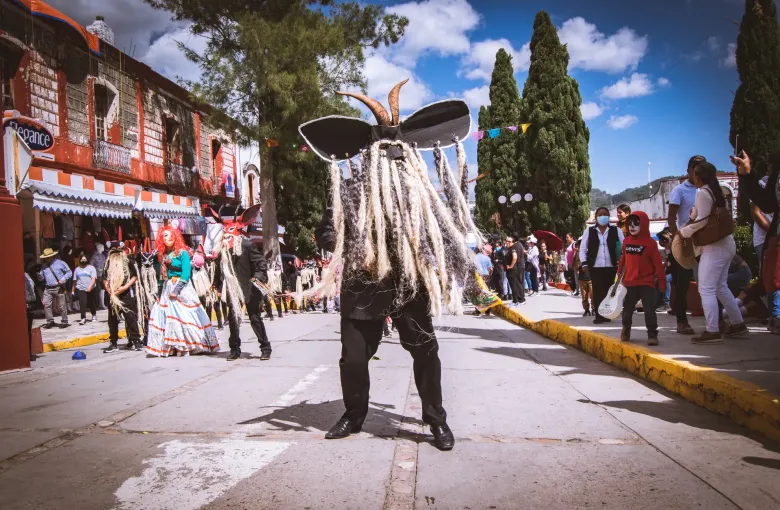
The signature Afro-Mexican tradition, performed around the Day of the Dead. Masked dancers in horsehair beards move to a stamping rhythm led by a figure called the Pancho and his consort, driven by a bull-roarer and a jawbone rasp rather than by drums. It is generally understood as having its origins in enslaved people's observance under Spanish rule, retained and transformed across centuries.
It is performed in the Costa Chica villages on those days, and it is a community observance rather than a scheduled show.
The chilena
The music of the coast, a dance form with Pacific South American roots carried north by sailors in the nineteenth century and reworked locally. Hearing it played on the coast, with the harp and the guitar, is hearing an exchange happen rather than a survival preserved.
The food
Coastal Oaxacan cooking here is different from the mole kitchens of the Oaxaca valleys: fish, plantain, coconut and a lighter hand. It is worth going for on its own.
The diaspora that is now in the United States
A substantial part of this community's story is that it no longer lives only on that coast. Migration from the Costa Chica and from the Mixteca has built Oaxacan communities in California, above all in Los Angeles and the Central Valley, and the Danza de los Diablos is now danced in those cities as well as in the villages the dancers' families came from.
For an American reader that makes this a reconnection in both directions rather than a one way journey to an origin. The tradition you might travel to see on the Costa Chica is very likely being performed within driving distance of you, by people who would tell you where in Oaxaca it came from. Starting there costs nothing and makes the trip a return rather than a first visit.
How to visit well
- Go around the Day of the Dead if you want to see the dance, and confirm dates locally rather than assuming.
- Go with local guides. The Costa Chica is not set up for tourism, which is part of its appeal and means the way in is through people.
- Spanish is essential. This is not a corridor where English is common.
- Ask before photographing, always, and especially at the dance.
- Pay for performance and teaching.
- Base yourself in Puerto Escondido or Oaxaca city and travel out, rather than expecting resort infrastructure on the coast.
Verify before you travel
Advisory boundaries, festival dates and local operators all change. Check the current position close to travel, and ask locally rather than relying on a published list.
Sources
- UNESCO World Heritage Centre: Mexico's State Party record: thirty six properties inscribed on the World Heritage List, twenty eight of them cultural, the most of any country in the Americas. Accessed 16 September 2026.
- UK Foreign, Commonwealth & Development Office: Mexico travel advice: the eleven states carrying an advisory against all but essential travel and the explicit exceptions within them, including the Copper Canyon rail route in Chihuahua and Sinaloa, Los Mochis and Mazatlan, Morelia and Patzcuaro in Michoacan, Manzanillo in Colima and Zihuatanejo and Ixtapa in Guerrero, and the statement that no travel can be guaranteed safe. Accessed 16 September 2026.
- UK Foreign, Commonwealth & Development Office: Mexico safety and security: the requirement to carry the passport and entry stamp and the refusal of copies or photographs, the illegality of bringing in or selling vaping devices, robbery by unlicensed taxi drivers and the sitio and pre-paid airport alternatives, the Cancun taxi protests that have pulled visitors from ride hailing cars, theft and hijacking on buses and the case for first class services on toll roads, carjacking on the Pacific Highway, methanol in spirit drinks, low hotel balcony railings, the hurricane season from June to November and Hurricane Otis at Acapulco in 2023, and the LGBT+ legal position. Accessed 16 September 2026.
Other Articles
Costa Chica: Visitor and Heritage Guide
Mexico Culture and Etiquette Guide