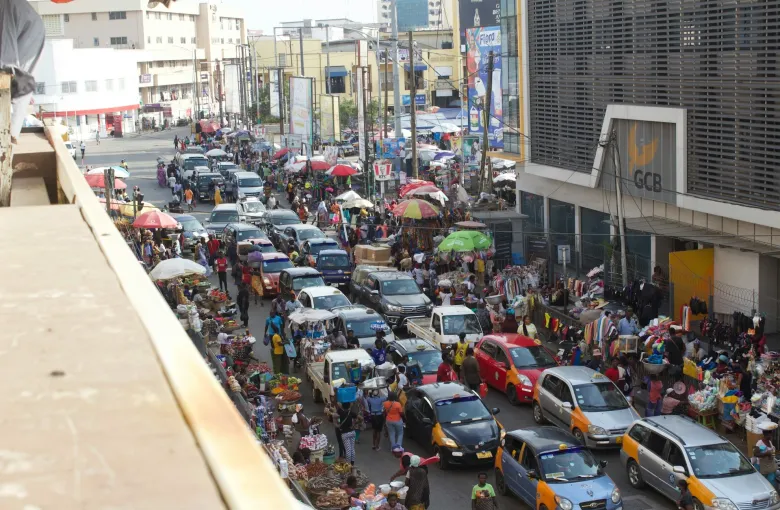
Ghana is straightforward to travel and slow to cross. Distances look modest on a map, but there is no passenger rail network worth planning around, and the time a journey takes depends far more on traffic and road surface than on the number of miles. Plan your days in hours, not distances.
The short version
- Almost everyone arrives at Kotoka International Airport (ACC) in Accra. It is the country’s main international gateway.
- Domestic flights save most of a day on the long north–south runs to Kumasi, Tamale and Takoradi.
- Trotros are the real local network — shared minibuses, constant, cheap, and not designed for luggage or timetables.
- Ride-hailing apps work well in Accra and remove the need to negotiate fares.
- For a group, a hired vehicle with a driver is usually the sane choice, and it is what organized tours use.
- Avoid driving between cities after dark. This is the single most useful rule on this page.
Airports and arrival
Kotoka International Airport sits inside Accra rather than far outside it, which is convenient until you meet the traffic. International flights use Terminal 3. Immigration will ask for your entry permission and may ask to see your yellow fever certificate, so keep both together and reachable rather than buried in a bag.
For the ride into the city, use the official taxi rank, a hotel transfer booked in advance, or a ride-hailing app from the designated pickup area. Decline the unmarked cars whose drivers approach you inside the terminal. If you have a domestic connection or a tour departure the same day, allow considerably more time than the map suggests: crossing Accra at rush hour can take an hour or more for a short distance.
Between cities
Three options, and the right one depends mostly on how much of your trip you are willing to spend in a vehicle.
- Fly for the long runs. Accra to Kumasi is roughly an hour in the air against five to six hours by road; Accra to Tamale is a little over an hour against ten to twelve. Several domestic carriers serve these routes; schedules and operators change, so check what is flying when you book rather than relying on last year’s advice.
- Take a coach for scheduled, comfortable long-distance travel. Intercity STC and the private operators run fixed departures with reserved seats and a hold for luggage — a different experience from a trotro.
- Drive, or be driven. Accra to Cape Coast on the coastal highway takes around three hours in good conditions, which is why it works as a two-night trip rather than a day trip. The road east into the Volta Region and north toward Kumasi is scenic and slower than you expect.
Within cities
In Accra, ride-hailing apps are widely used, and they solve the two things visitors find hardest: knowing the fare in advance and explaining where you are going. Coverage is good in the city and thins outside it.
A conventional taxi hired for yourself is called a dropping taxi, and the fare is agreed before you get in, not after. Shared taxis run fixed routes for a fixed low fare and will stop for other passengers. Trotros work the same way on a larger scale: the mate leans out and calls the destination, you board if it is yours, and you pay on the way.
Walking is pleasant in some districts and awkward in others. Sidewalks are interrupted, uneven, and in places run alongside open storm drains. Watch your feet rather than your phone.
Hiring a driver
For anything beyond a single city, hiring a vehicle with a driver is the standard arrangement, and it costs less than most visitors expect when split across a group. A good driver is also a fixer: they know which road is closed, where to stop, and how long a stretch really takes.
Agree the terms in advance and in writing where you can — the itinerary, the daily rate, whether fuel is included, who pays for parking and tolls, and what happens to the driver’s meals and accommodation on overnight trips. Ambiguity here is the usual source of an awkward conversation later.
If you are traveling on an organized tour, this is already handled: transport between sites, and a driver who works with the guide, is part of what you are buying.
What to avoid
- Intercity driving after dark. Long stretches are unlit, lane markings fade, shoulders are narrow or absent, and livestock and pedestrians share the road. Arrive before sunset.
- Treating a stated departure time as a departure time. Trotros and shared taxis leave when they are full. Coaches with reserved seats are the exception.
- Long trotro journeys with luggage. Fine for a short hop; a poor idea for three hours with a suitcase.
- Unmarked cars at the airport or transport hubs. Use the official rank, an app, or a pre-booked transfer.
- Tight connections. Accra traffic is the most common reason a plan slips.
Common questions
Do I need to rent a car to see Ghana?
No, and most visitors should not. Between ride-hailing in the cities, domestic flights for the long runs and a hired vehicle with a driver for touring, there is rarely a good reason to take on unfamiliar roads yourself.
How long is the drive from Accra to Cape Coast?
About three hours in good conditions. Leaving Accra during the morning rush can add substantially to that, so an early start earns its keep.
Are Uber and similar apps available in Ghana?
Ride-hailing is well established in Accra and used routinely by residents and visitors alike. Coverage is thinner in smaller cities, so do not build a plan that depends on it outside the capital.
Is there a train between cities?
Not one you can plan a trip around. Ghana’s railway has been the subject of long-running redevelopment, but there is no intercity passenger service that a visitor should rely on.
Is it safe to travel by trotro?
Trotros are how millions of people get to work, and for a short urban hop they are perfectly reasonable. For long journeys, with luggage, or after dark, choose a coach, a hired vehicle or a flight instead.
Other Articles
Ghana Travel Safety Guide

Ghana Packing List