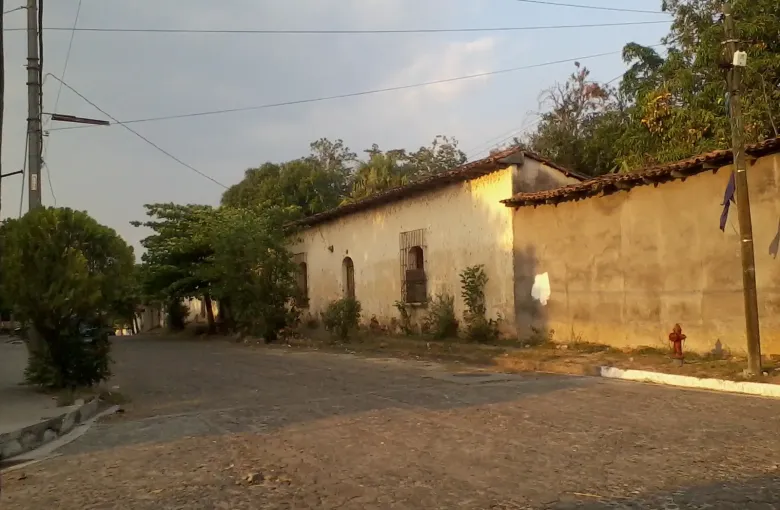
Suchitoto sits above Lake Suchitlan an hour or so north of San Salvador, and it is the town most people mean when they say El Salvador has kept something. Low white and ochre buildings, tiled roofs, a broad plaza, a white church, and streets of large rounded cobbles that have not been replaced with anything easier.
⚠ It is not a World Heritage Site
Suchitoto is frequently described as one and it is not. El Salvador has exactly one inscribed property, the Joya de Ceren Archaeological Site, and Suchitoto is not on the Tentative List either. That takes nothing away from the town. It is simply not the thing people assume it is on paper, and this cluster would rather say so than repeat a comfortable error.
Walking it
The pleasure of Suchitoto is unstructured. The grid is small, the sightlines end in either the church or the lake, and the right way to spend a first afternoon is to walk the streets without a destination. Doorways stand open onto courtyards. Galleries and workshops occupy buildings that look like houses because they are houses.
⚠ The cobbles are the practical point. They are large, rounded and uneven, the camber is pronounced, and several streets are steep. This is hard walking for anyone unsteady on their feet, and it is genuinely difficult with a wheelchair or a stroller. Bring a shoe with a real sole. The accessibility guide in this cluster treats this properly rather than in passing.
The lake
Lake Suchitlan is a reservoir rather than a natural lake, created by the damming of the Lempa. It draws large numbers of migratory birds, and boat trips out onto it are easy to arrange locally and are the best way to see the town from below. Arrange them through your accommodation rather than at the water's edge.
Arts and the reason people stay
Suchitoto is the cultural town in a way that is unusual for somewhere this small: galleries, a theater, workshops, resident artists, and a calendar of small festivals. It is why visitors who meant to stay a night stay three, and why a great deal of Salvadoran cultural life passes through a place with a few thousand people in it.
⚠ The history underneath it
This region was heavily affected during the civil war that ended in 1992, and Suchitoto was close to the fighting. Many people left and some came back. That history is present in the town and it is within living memory for most adults there.
The etiquette is the same as elsewhere in this cluster. Do not open the subject. If someone raises it, listen. Do not treat a place where people died as a photograph. This guide does not narrate that history, because it is not this site's to narrate.
Practicalities
An hour and a half from San Salvador on a good road, and a very easy overnight. Arrange the transfer rather than taking a public bus, per the transport advice in this cluster. Cash is more useful here than in the capital, in small denominations.
Sources
- UNESCO World Heritage Centre: El Salvador States Party record: exactly one property inscribed on the World Heritage List, the Joya de Ceren Archaeological Site, inscribed in 1993, and separately six sites on the Tentative List, an inventory of properties a country intends to consider for nomination in future, among them the Gulf of Fonseca, Cara Sucia and El Imposible, and Chalchuapa. Accessed 17 September 2026.
- UK Foreign, Commonwealth and Development Office: El Salvador safety and security: the state of exception declared in 2022 in response to a sharp rise in gang related murders and recorded as remaining in place, under which police hold additional powers, arrests are far more numerous and are sometimes made without much evidence, people may be detained for much longer before trial and ordinary legal safeguards have been weakened or removed; the crowd disaster at the Cuscatlan Stadium in May 2023 in which at least 12 people died and more than 500 were injured; the advice not to use unofficial taxis and to take a radio dispatched, pre booked or hotel taxi instead; the record that public buses are repainted old US school buses and are not safe because of petty crime; the warning that rivers tend to be contaminated and are unsafe to swim or bathe in; the record that El Salvador has active volcanoes, at least 6 of which are monitored, and the advice to get local advice before climbing one and to walk in daylight with a guide; the tourist police contact number 2224 2705; and the money guidance that the US dollar is what a visitor needs, that it is almost impossible to change British pounds anywhere in the country, that bitcoin may not be accepted everywhere and a visitor should make sure they can access US dollars, and that regular and bitcoin ATMs are widely available particularly in San Salvador and La Libertad. Accessed 17 September 2026.
Other Articles
Best Time to Visit El Salvador
Accessible Travel in El Salvador