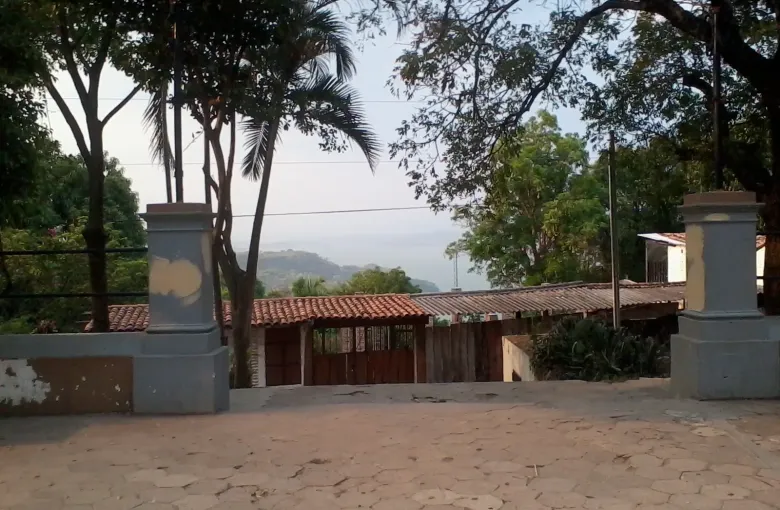
Joya de Ceren is a pre Hispanic farming village that was buried under volcanic ash and preserved with its buildings, its household objects and its planted fields intact. It was inscribed on the World Heritage List in 1993, and it is the only property El Salvador has on that list.
Why it matters more than it looks
Most archaeology of this region is monumental: pyramids, ball courts, the residences of rulers. Joya de Ceren is none of that. It is a village of ordinary households, caught at the moment they were abandoned, and what it preserves is the part of the past that usually rots.
The ash sealed the site quickly and kept out the air. What survived is domestic: the buildings people slept and cooked and stored grain in, the objects still where they were put down, and the fields still showing what had been planted and how it was laid out. There is no other site in the Americas that tells you this much about how ordinary people actually lived.
It is sometimes described as an American Pompeii. The comparison is useful for the mechanism and misleading for everything else: this is not a city, there are no bodies, and the scale is a hamlet rather than a metropolis. What it has in common with Pompeii is that the catastrophe was also the preservation.
What you are looking at
The structures stand in excavation pits beneath protective roofing, which is what keeps them from dissolving in the rain. Earthen walls, doorways and internal fittings survive to a height that lets you read the plan of a building rather than infer it. Walk slowly and look for the small things, because the small things are the point here: the shape of a store room, the level of a threshold, the mark of a post.
Interpretation is on site and a guide is worth taking. Much of what is significant needs pointing out, and a walk round without one risks reading as a set of low walls.
Visiting
The site is west of San Salvador and is an easy half day from the capital, often combined with San Andres nearby. Shade is limited and the middle of the day is hot; early is better. Wear a shoe with grip, because the walkways around the pits are uneven.
Check opening days locally before setting out rather than relying on a published schedule, and confirm whether photography is permitted where you intend to use it.
⚠ One inscription, and six sites that are not
El Salvador has exactly one property on the World Heritage List and this is it. Six further sites sit on the country's Tentative List, which is an inventory of properties a country intends to consider for nomination in future and which confers no inscription and no status. Among them are the Gulf of Fonseca, Cara Sucia and El Imposible, and Chalchuapa.
That distinction matters in this cluster more than most, because two of the three heritage guides here are about places that are not inscribed and are often described as though they were. Suchitoto and the Ruta de las Flores are both worth your time. Neither is a World Heritage Site.
Sources
- UNESCO World Heritage Centre: Joya de Ceren Archaeological Site, inscribed 1993, a pre Hispanic farming village buried under volcanic ash and preserved with its buildings, household objects and planted fields, and the only property El Salvador has on the World Heritage List. Accessed 17 September 2026.
- UNESCO World Heritage Centre: El Salvador States Party record: exactly one property inscribed on the World Heritage List, the Joya de Ceren Archaeological Site, inscribed in 1993, and separately six sites on the Tentative List, an inventory of properties a country intends to consider for nomination in future, among them the Gulf of Fonseca, Cara Sucia and El Imposible, and Chalchuapa. Accessed 17 September 2026.
- UK Foreign, Commonwealth and Development Office: El Salvador safety and security: the state of exception declared in 2022 in response to a sharp rise in gang related murders and recorded as remaining in place, under which police hold additional powers, arrests are far more numerous and are sometimes made without much evidence, people may be detained for much longer before trial and ordinary legal safeguards have been weakened or removed; the crowd disaster at the Cuscatlan Stadium in May 2023 in which at least 12 people died and more than 500 were injured; the advice not to use unofficial taxis and to take a radio dispatched, pre booked or hotel taxi instead; the record that public buses are repainted old US school buses and are not safe because of petty crime; the warning that rivers tend to be contaminated and are unsafe to swim or bathe in; the record that El Salvador has active volcanoes, at least 6 of which are monitored, and the advice to get local advice before climbing one and to walk in daylight with a guide; the tourist police contact number 2224 2705; and the money guidance that the US dollar is what a visitor needs, that it is almost impossible to change British pounds anywhere in the country, that bitcoin may not be accepted everywhere and a visitor should make sure they can access US dollars, and that regular and bitcoin ATMs are widely available particularly in San Salvador and La Libertad. Accessed 17 September 2026.
Other Articles
Best Time to Visit El Salvador
El Salvador Packing List