The quick answer
Three calendars run at once in Egypt: the Islamic lunar year, which moves; the Coptic Christian year, which is close to fixed; and a spring festival older than either. Add one astronomical event — the sun reaching the inner sanctuary at Abu Simbel — and you have the shape of the Egyptian year.
The Islamic calendar, and why it moves
The Hijri year is lunar and roughly eleven days shorter than the Gregorian one, so Islamic observances fall earlier each year and drift through the seasons over a cycle of about three decades. Anyone planning a trip needs to check where they land in the specific year they are traveling, rather than assuming a month.
Ramadan
A month of fasting from dawn to sunset. Days are quiet and shortened; evenings are the opposite. Iftar, the meal that breaks the fast, turns whole streets into shared tables, and cities stay busy long into the night. Sites and museums remain open but hours frequently change, and restaurants outside hotels may not serve during daylight. It is one of the most rewarding times to be in Egypt and the least convenient, in roughly equal measure.
Eid al-Fitr and Eid al-Adha
The festival that ends Ramadan, and the feast of the sacrifice that follows about ten weeks later. Both are major public holidays and both are peak domestic travel periods: transport fills, and popular sites are busy with Egyptian families. New clothes, family visiting and a great deal of food. If you are there, you will be included.
The Coptic calendar
Egypt’s Coptic Orthodox Christians follow their own liturgical year. Coptic Christmas falls on 7 January and is a public holiday, marked by a midnight liturgy and by family celebration. Coptic Easter moves with the Orthodox calculation and is the most important date of the Coptic year, preceded by a long fast. Churches in Old Cairo and the desert monasteries are at their most alive at these times, and visitors are generally welcome at services provided they are dressed and behave as guests.
Sham el-Nessim
The Monday after Coptic Easter, and the oldest thing on this list: a spring festival with roots in pharaonic Egypt that is celebrated by Egyptians of every faith. Families go outdoors — parks, riverbanks, gardens — and eat salted fish (fesikh), spring onions and colored eggs. It is entirely secular in practice and it is the single most universally observed day in the Egyptian year. If your trip coincides, spend it outdoors with everyone else.
The sun at Abu Simbel
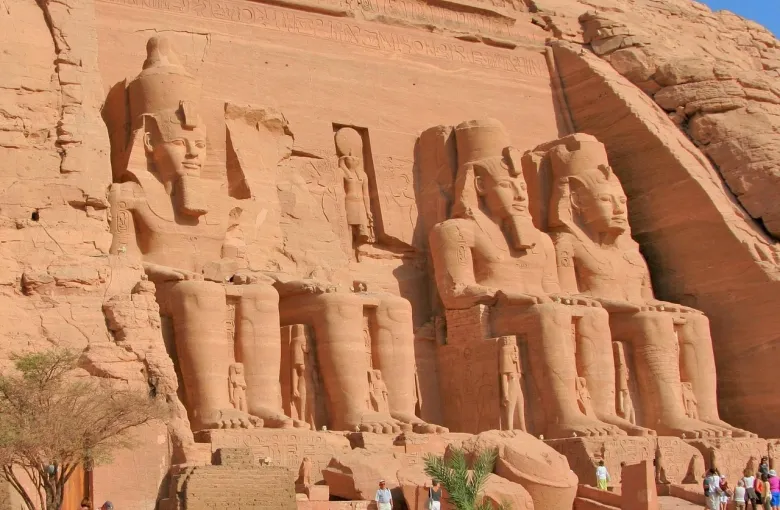
Twice a year, on 22 February and 22 October, the rising sun reaches down the full length of the Great Temple of Ramesses II and lights the statues in the inner sanctuary. It is one of the very few events in the Egyptian calendar that is fixed to a date rather than to a moving religious year, and it draws large crowds and a festival atmosphere at Aswan and Abu Simbel. Note that the alignment survived the relocation of the temples in the 1960s, when the entire complex was cut apart and rebuilt on higher ground above the rising waters of Lake Nasser — a detail that makes the event as much a monument to twentieth-century engineering as to ancient astronomy.
Other things worth timing for
Moulids — saints’ day festivals held around the shrines of Sufi and Coptic figures — are among the most vivid public gatherings in Egypt, with music, processions and enormous crowds. They follow local and religious calendars and are best approached with a guide who knows the specific event. Coptic monastery feast days in the Wadi Natrun and the Red Sea monasteries draw pilgrims in numbers. And Egypt’s national holidays — Revolution Day on 23 July and Armed Forces Day on 6 October among them — close government offices and banks.
Common questions
Should I avoid traveling during Ramadan?
Not necessarily, but travel informed. Expect changed hours, reduced daytime services and a very different atmosphere. If your priority is efficient sightseeing, choose another month; if it is experiencing the country, it is a strong argument for going.
Are the Eid holidays a problem?
They are a crowding and transport problem rather than a closure problem. Book internal travel well ahead and expect the major sites to be busy with domestic visitors.
Can I attend a Coptic service or a moulid as a visitor?
Generally yes, dressed appropriately and behaving as a guest. For a moulid in particular, go with someone who knows the event.
Seeing it on a LABUSA Travel journey
When our Egypt departures fall across one of these dates we build the itinerary around it rather than through it — an iftar rather than a missed dinner, the Abu Simbel alignment planned for rather than collided with. Tell us at booking if a particular date matters to you.
Other Articles
Egypt Culture and Etiquette Guide

Best Time to Visit Egypt