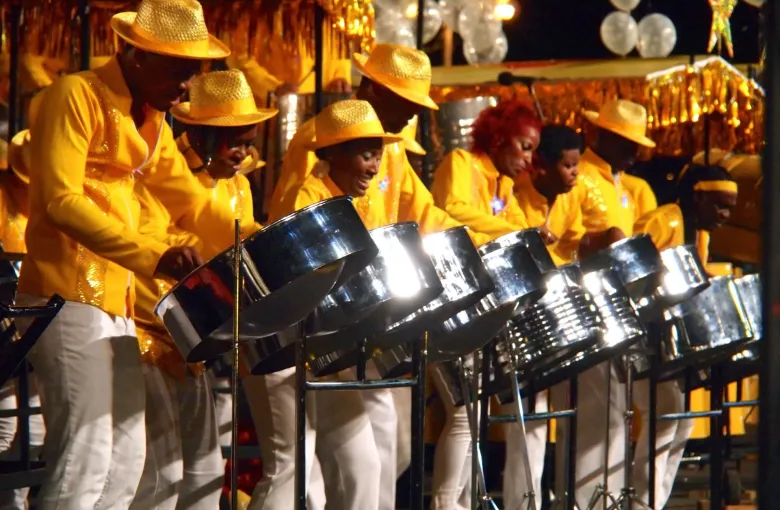
Why the food here is not like the rest of the region.
Because the population is not like the rest of the region. The country's own Carnival authority sets out part of that story: the French were developing their festivities here from 1783 for half a century, Africans started to participate in the festivities from 1833 after the Emancipation Bill was passed, and the calypso that grew out of it traces to African traditions of improvised songs brought by enslaved peoples, with the word itself variously attributed to kaiso, a Hausa word for bravo, the French carrousseaux, the Spanish calliso and the Carib carieto.
Four naming traditions for one word is a fair picture of the whole country. Spanish, French and British administration, African and later South Asian arrival, and an Indigenous presence that long predates all of them. The food sits on top of that, and it is why a plate here does not look like a plate anywhere else in the Caribbean.
Doubles.
Two pieces of soft fried bara bread around curried channa, chickpeas cooked down with turmeric and cumin, finished with whatever pepper and chutney you ask for. It is sold from roadside stalls and carts, wrapped in paper, eaten standing up, and it is the country's breakfast in the way that nothing else quite is.
Ordering is the whole ritual. You will be asked about pepper, and the answer commits you. Slight is a sensible opening position if you do not know the stall. The queue moves fast and it moves in a conversation you are welcome to join.
Bake and shark.
Fried flatbread split and filled with seasoned fried fish, then loaded by you rather than for you: lettuce, tomato, cucumber, pineapple, garlic sauce, tamarind, chadon beni, pepper. The condiment table is the point, and the queue at it is where the decisions get made.
Its home is the beach on Trinidad's north coast, and a visitor who has come over the range for the day will usually eat one within sight of the water.
Roti, and everything around it.
Roti here is a whole family rather than a dish: dhalpuri split and filled with ground split peas, paratha torn into pieces as it comes off the tawa, buss up shut, and the curries that go with them. Curry goat, curry duck, curried mango, pumpkin, bodi and channa. Pelau, cooked down with browned sugar until the rice takes the color, belongs to the other side of the same kitchen.
There is no useful line here between the country's Indian-descended cooking and its African- descended cooking. Both are Trinidadian, and a single household table will usually carry both.
Eating well and safely.
Roadside food is not a risk to be managed around in this country; it is the cooking. The sensible approach is the same as a local's: eat where there is a queue, eat what is being cooked in front of you, and go at the hours the stall is busy.
The one specific instruction from official advice concerns drinks rather than food, and it belongs here because it applies in bars and at stalls: avoid accepting drinks from anyone you do not know, and do not leave drinks unattended, and keep food and drinks under supervision. That is a personal-safety instruction, not a hygiene one.
What this page will not claim.
It will not tell you which stall is best, because no source this cluster can cite ranks them and a recommendation without one is somebody's advertising. It will not give you prices, because this cluster publishes no exchange rate and a local figure without one is not useful. And it will not tell you that any of this is the oldest, the original or the only authentic version, because those arguments are enjoyed here and settled by nobody.
If you would like a trip built around markets, stalls and a cooking morning rather than restaurants, tell us and we will build it that way.
Sources
- National Carnival Commission of Trinidad and Tobago: the national Carnival authority history pages: that Carnival in Trinidad and Tobago is celebrated before the commencement of the Lenten season; that from 1783 for half a century the French developed their Carnival, a season of festivities extending from Christmas to Ash Wednesday consisting of dinners, balls, concerts and hunting parties; that Africans started to participate from 1833 after the Emancipation Bill was passed and brought Canboulay to the festivities; that Canboulay was first played on August 1st, Emancipation Day, but subsequently took place after midnight on Dimanche Gras, the Sunday before Carnival; that in early celebration by the masses activities were held over the three days preceding Ash Wednesday, but that in 1943 Carnival on the street was restricted to the Monday and Tuesday and celebrations were banned for the duration of the Second World War; that the steelband developed from 1935 to 1945 as Tamboo Bamboo and metal bands were transformed, that around 1935 some bands began using metal containers in place of bamboo, that the accidental discovery was made that a change of pitch occurred when the surfaces were hammered and stretched, and that the first pan or ping pong appeared with enough notes to carry a simple melody; and that calypso, called a poor man's newspaper in times when literacy was not widespread, traces its roots to African traditions of improvised songs, with the name variously attributed to kaiso, a Hausa word for bravo, the French carrousseaux, the Spanish calliso and the Carib carieto. Accessed 21 September 2026.
- UK Foreign, Commonwealth and Development Office: Trinidad and Tobago travel advice, safety and security: that there is a high level of violent crime including gang-related attacks and shootings and that instances of homicides and armed robberies are common; the named areas in which to be cautious, including downtown Port of Spain east of Charlotte Street, Carenage, Sea Lots, Belmont, Laventille, Morvant, Barataria, Cocorite and the interior of the Queens Park Savannah; that a significant portion of violent crime is gang-related and the listed precautions, including avoiding walking at night, keeping valuables out of sight in a moving vehicle, and using well-lit ATMs during daylight; that criminals have used drugs, deception and sexual solicitation including via dating apps to facilitate robbery and sexual assault; that robberies and opportunistic crime may occur during the carnival period; that providers of recreational and adventure tourism may not meet UK safety standards; that it is an offense for anyone, including children, to dress in camouflage clothing or bring any into the country; that possession of up to 30g of cannabis or 5g of cannabis resin has been decriminalised, that smoking cannabis in public spaces or while operating a vehicle is not allowed, and that being stopped with those amounts can bring a fine of up to 50,000 Trinidad and Tobago dollars; that in March 2025 consensual same-sex activity was reinstated as a crime punishable by up to 5 years imprisonment, that it is also illegal for LGBT+ foreign nationals to enter the country, and that neither of these laws has been enforced in recent times; that entering private property without permission can bring a fine of up to 750,000 Trinidad and Tobago Dollars or imprisonment for up to 25 years and that legal occupants may use defensive and even deadly force against trespassers; that a UK photocard driving license may be used for up to 90 days and that an international driving permit is needed beyond that; that driving standards are mixed, that high-speed accidents on the main highways often result in fatalities, that some roads are narrow, winding and unlit and that pedestrians often walk on the roads; that Trinidad and Tobago is rarely affected by hurricanes but can have severe storms; that earthquakes are a risk and that the last serious earthquake was in 2018; and that travelers should monitor the alert level of Kick em Jenny, an underwater volcano located off the coast of Grenada and about 200km from Trinidad, which erupts every few years. Accessed 21 September 2026.
- TravelHealthPro, the National Travel Health Network and Centre: Trinidad and Tobago country page: that there are no certificate requirements under International Health Regulations and that there is a risk of yellow fever transmission in parts of the country; that yellow fever vaccination is recommended for travelers aged 9 months and older traveling to densely forested areas on the island of Trinidad and is not recommended for cruise ship passengers; that there is a risk of dengue in the country and a risk of Zika virus in the country; that on 24 March 2026 the Ministry of Health reported a confirmed detection of yellow fever in a deceased monkey with no human cases detected, and that the last significant yellow fever outbreak in Trinidad occurred in 1979; that as of 2 April 2025 the Ministry of Health was investigating a cluster of five malaria cases on the island of Trinidad with the first case identified on 27 March 2025, that it was unclear whether it was locally acquired and that the species had not been confirmed, and that mosquito bite avoidance is recommended for all travelers; and that the capital is Port of Spain, the official language English and the monetary unit the Trinidad and Tobago dollar. Accessed 21 September 2026.
Other Articles

Trinidad and Tobago Culture and Etiquette Guide
Trinidad and Tobago Currency and Money Guide