What is not published, said first.
No source in this cluster's register publishes an accessibility standard, a rating scheme or an audit for hotels, transport or attractions in Trinidad and Tobago. The official travel advice points travelers to general guidance on disability and travel abroad rather than to anything country-specific.
That absence is the honest headline. This page gives what can be established from terrain, from the official advice and from the structure of the country, and it flags every point where a provider needs to be asked directly.
Two islands, two different problems.
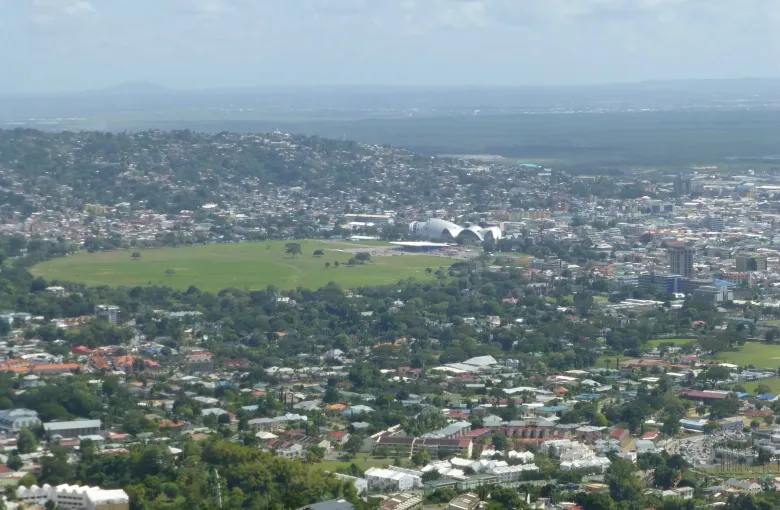
Trinidad's main centers are flat, built up and served by roads. The difficulty there is not gradient but surface and traffic. The official advice records that some roads are narrow and winding, and road surfaces are of a mixed standard, that pedestrians often walk on the roads, and that road signs and hazards may not be easily visible. A pavement that exists is not necessarily a pavement that continues.
The Northern Range and Tobago's Main Ridge are the opposite: steep, wet and unpaved by design. UNESCO's file on the Main Ridge notes that its higher forest receives the greatest amount of rainfall. Trails there are not adapted and should not be assumed to be.
Tobago's coast offers the country's most level access to water. A jetty or a boardwalk out over shallow water is a different proposition from a beach approached across soft sand, and where one exists it is worth building a day around.
The questions to ask before you book.
Ask about the approach to the room, not the room. Steps between a car park and a lobby, or between a lobby and a lift, are the commonest obstacle and the least often mentioned.
Ask for the door width in centimeters and the height of the bed, rather than whether a room is accessible. The word means different things to different operators.
Ask whether a bathroom has a step into the shower, a fixed seat and a grab rail, each as a separate question.
Ask how a transfer vehicle is boarded, and whether a wheelchair travels with the passenger or follows. Maxi taxis are shared minibuses boarded by a step.
Ask, for any tour, what the walking surface is and how far it is from where the vehicle can stop. Guided birding in particular may involve standing for long periods on uneven ground.
Medical cover is not optional here.
The official advice records that medical facilities can be limited in some areas of Trinidad and Tobago, that private clinics can treat most ordinary problems, but medical evacuation may be necessary in more serious cases, and that travelers should have adequate travel health insurance and accessible funds to cover the cost of any medical treatment abroad and repatriation.
For a traveler with an existing condition that changes the arithmetic of a policy rather than being a box to tick. In an emergency, call 811 and ask for an ambulance, and contact your insurer quickly if you are referred for treatment.
Equipment and medication.
Carry medication in original labeled packaging with a copy of the prescription, and bring the whole trip's supply plus a margin, because a specific item may not be stocked outside the main centers. For mobility equipment, bring spares of anything that cannot be replaced locally within a day.
One law that affects choice of clothing.
It applies to everyone and is worth repeating here because adaptive clothing sometimes comes in unexpected patterns: it is an offense for anyone, including children, to dress in camouflage clothing or bring any into the country.
If you would like an itinerary built around confirmed access, level ground and short transfer legs, tell us what you need and we will ask the providers rather than assume.
Sources
- UK Foreign, Commonwealth and Development Office: Trinidad and Tobago travel advice, safety and security: that there is a high level of violent crime including gang-related attacks and shootings and that instances of homicides and armed robberies are common; the named areas in which to be cautious, including downtown Port of Spain east of Charlotte Street, Carenage, Sea Lots, Belmont, Laventille, Morvant, Barataria, Cocorite and the interior of the Queens Park Savannah; that a significant portion of violent crime is gang-related and the listed precautions, including avoiding walking at night, keeping valuables out of sight in a moving vehicle, and using well-lit ATMs during daylight; that criminals have used drugs, deception and sexual solicitation including via dating apps to facilitate robbery and sexual assault; that robberies and opportunistic crime may occur during the carnival period; that providers of recreational and adventure tourism may not meet UK safety standards; that it is an offense for anyone, including children, to dress in camouflage clothing or bring any into the country; that possession of up to 30g of cannabis or 5g of cannabis resin has been decriminalised, that smoking cannabis in public spaces or while operating a vehicle is not allowed, and that being stopped with those amounts can bring a fine of up to 50,000 Trinidad and Tobago dollars; that in March 2025 consensual same-sex activity was reinstated as a crime punishable by up to 5 years imprisonment, that it is also illegal for LGBT+ foreign nationals to enter the country, and that neither of these laws has been enforced in recent times; that entering private property without permission can bring a fine of up to 750,000 Trinidad and Tobago Dollars or imprisonment for up to 25 years and that legal occupants may use defensive and even deadly force against trespassers; that a UK photocard driving license may be used for up to 90 days and that an international driving permit is needed beyond that; that driving standards are mixed, that high-speed accidents on the main highways often result in fatalities, that some roads are narrow, winding and unlit and that pedestrians often walk on the roads; that Trinidad and Tobago is rarely affected by hurricanes but can have severe storms; that earthquakes are a risk and that the last serious earthquake was in 2018; and that travelers should monitor the alert level of Kick em Jenny, an underwater volcano located off the coast of Grenada and about 200km from Trinidad, which erupts every few years. Accessed 21 September 2026.
- UK Foreign, Commonwealth and Development Office: Trinidad and Tobago travel advice, health: that in an emergency a traveler should call 811 and ask for an ambulance; that at least 8 weeks before a trip a traveler should check the latest vaccine recommendations and where to get vaccines; that the yellow fever vaccination is recommended for some travelers if visiting Trinidad; that the 2022 UNAIDS Country Factsheet estimated around 12,000 adults aged 15 or over in the country were living with HIV; that the legal status and regulation of some medicines can differ from the country they were prescribed in; and that medical facilities can be limited in some areas, that private clinics can treat most ordinary problems but medical evacuation may be necessary in more serious cases, and that adequate travel health insurance and accessible funds are needed to cover treatment and repatriation. Accessed 21 September 2026.
- UK Foreign, Commonwealth and Development Office: Trinidad and Tobago travel advice: that the Trinidad and Tobago government introduced a State of Emergency on 3 March following persistent violent crime and criminal activity, which gives authorities additional powers of search, arrest and detention; that no curfew or restrictions on movement have been imposed and that travelers should follow the instructions of police and local authorities; and the standing instruction to research your destinations and get appropriate travel insurance. Accessed 21 September 2026.
Other Articles
Trinidad and Tobago for Senior Travelers
Getting Around Trinidad and Tobago