The short version
There is no single Spanish cuisine. There are Basque, Galician, Catalan, Valencian, Andalusian, Castilian, Asturian and Canarian cuisines, and the difference between them is the point of eating your way across the country rather than eating the same three dishes in eight cities.
The adjustment that actually matters is the clock. Spain eats later than almost anywhere else in Europe, lunch is the substantial meal of the day rather than a sandwich, and a restaurant that looks empty is usually just open too early.
How tapas actually work
A tapa is a small plate that comes with a drink, and the convention varies by city. In some places, Granada above all, a tapa arrives free with each drink and you have no say in what it is. In others you order and pay for each plate. The style of eating is to have one drink and one plate in a bar, then walk to the next bar: the crawl is the meal, and settling into one place for the evening is a different, more formal thing.
Two words worth knowing at the counter. A racion is a full plate meant for sharing rather than a small one, and a media racion is half of it. Ordering three raciones for two people is the most common way visitors end up with far too much food.
The regions, in one paragraph each
The Basque Country has the densest concentration of serious cooking in Spain, and in San Sebastian and Bilbao the bar snack has its own name, the pintxo, usually skewered and laid out on the counter. Galicia is about the Atlantic: octopus, percebes, scallops and the best shellfish in the country. Asturias and Cantabria bring cider, bean stews and strong cheeses.
Catalonia cooks with the sea and the mountains in the same meal, and Barcelona's markets are worth visiting even if you eat nothing. Valencia is the home of paella, which is a rice dish from a specific place rather than a generic word for rice with things in it. Andalusia is fried fish, cold soups built for the heat, sherry from Jerez and cured ham. Castile is roast meat, chickpeas and the plateau's winter food. The Canary Islands have their own potatoes, sauces and bananas and cook closer to the Atlantic than to the mainland.
Markets, and how to use one
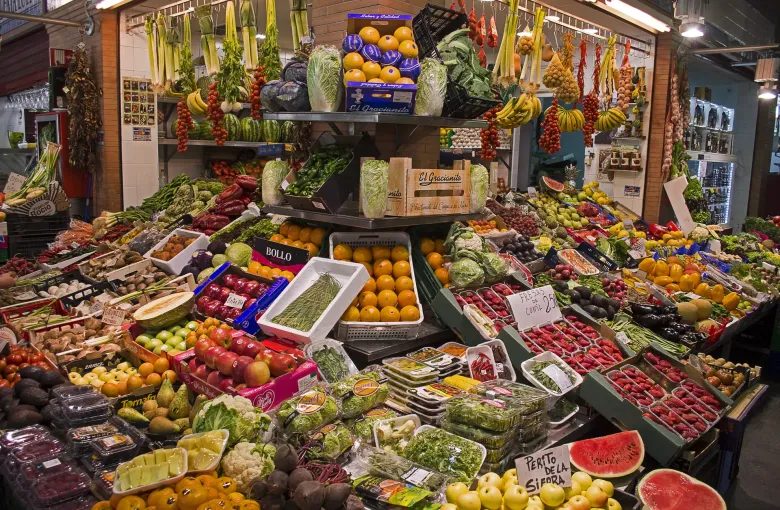
Every Spanish city of any size has a covered market, and the good ones are still where people buy food rather than where visitors buy a snack. Prices are posted on hand-written cards, stalls specialize narrowly, and the person behind the counter will tell you what is good today if you ask. Take cash for small purchases, because a market stall is one of the few places in Spain where a card is inconvenient. Our money guide covers the rest.
Drinking
Wine is regional too, and ordering the local one is almost always the right move: Rioja and Ribera del Duero inland, Albarino in Galicia, cava in Catalonia, sherry in Andalusia. Beer comes small and cold by default, which is a feature in a hot country. Vermouth before lunch is a real tradition rather than a revival.
Two legal points from our safety sources belong here rather than in a footnote. It is illegal to drink alcohol in the street in some areas of Spain, with on-the-spot fines. And the UK advisory notes that drinks served in Spanish bars are often stronger than a visitor expects, alongside its advice to buy your own drinks and keep them in sight.
Eating well without a reservation
Look for a menu del dia at lunch, which is the fixed midday menu most places serve on weekdays and the best value meal in the country. Avoid anywhere with photographs of the food outside and a person at the door inviting you in. Walk two streets back from the cathedral. If a bar is full of people standing up, that is the recommendation.
Dietary needs and food safety
Vegetarian and vegan eating has become straightforward in the cities and remains harder in small inland towns, where the default assumes ham. Learn the phrase for what you cannot eat rather than relying on a menu translation, and be specific about fish and shellfish in coastal regions, where they are often not counted as meat.
Tap water is drinkable across mainland Spain. On food safety generally, the US Centers for Disease Control and Prevention suggests considering hepatitis A vaccination for most travelers, and particularly for anyone eating in smaller cities, villages or rural areas. That is the whole of the health caution that applies to eating here. Read our festivals guide for the food that only appears at certain times of year.
Sources
- UK Foreign, Commonwealth & Development Office: Spain safety and security: street theft and distraction teams, vehicle crime, the identification requirement, regional alcohol and swimwear rules, balconies, taxis, driving rules, wildfires and extreme heat. Accessed 16 September 2026.
- US Centers for Disease Control and Prevention: Travelers’ Health, Spain: routine vaccines, hepatitis A and B, measles, rabies, and yellow fever vaccine neither recommended nor required. Accessed 16 September 2026.
Other Articles

Spanish Culture and Etiquette
Festivals and Events in Spain