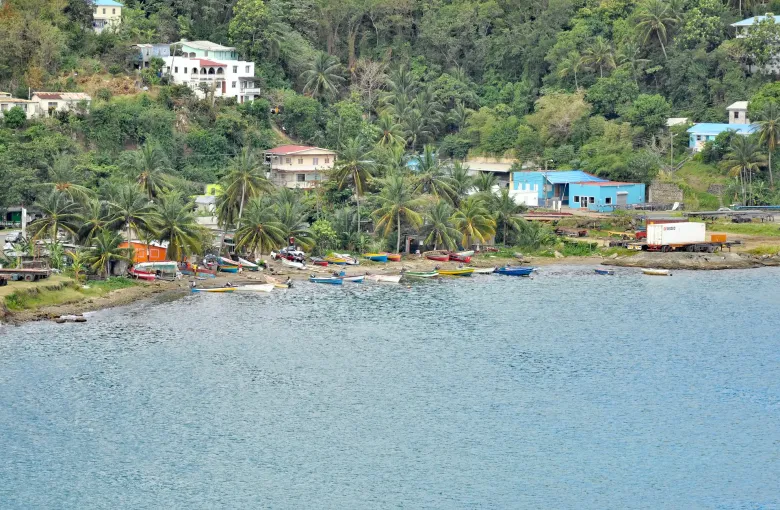
Rain is the hazard, and the ground is why.
The hurricane window is June 1 to November 30 by the National Hurricane Center's definition, and June to November in the FCDO's rounder phrasing. What the advice emphasizes, though, is not wind. It is that the season often brings heavy rains, which may cause flash floods and landslides.
Saint Lucia is a steep island, and the same advice describes minor and rural roads as narrow, with steep gradients, hairpin bends and blind corners, some of them unlit. Heavy rain on that terrain is a driving problem and an access problem before it is anything else.
After a storm, the advice is specific about what stops working: power, communications, transport and water supplies can be disrupted, and even in holiday resorts, utility services cannot be guaranteed.
Earthquakes.
The advice records that earthquakes are a risk in the Caribbean and tremors are occasionally felt in Saint Lucia. It points readers to the US Federal Emergency Management Agency for what to do before, during and after one. That is the whole of what is published, and this page does not extend it.
Two volcanoes, and neither one is here.
This is the part most easily got wrong, because the advice on Saint Lucia's page names two volcanoes and neither of them is in Saint Lucia.
Kick 'em Jenny is an underwater volcano 5 miles off the coast of Grenada. Travelers are asked to check its alert level, to observe any maritime exclusion zones, and to follow local authorities if activity increases. It matters to anyone on the water in the southern Caribbean; it is not a feature of this island.
La Soufriere is on the nearby island of Saint Vincent. Travelers are asked to check its alert level too, and the advice gives the reason directly: its eruption in 2021 sent ash over Saint Lucia, which caused some disruption.
That is the honest shape of volcanic risk here. Saint Lucia has volcanic ground of its own, and the drive-in volcano near Soufriere is one of the island's best known places to visit. But the two volcanoes the official advice tells a visitor to monitor belong to Grenada and to Saint Vincent, and the effect Saint Lucia felt in 2021 was ash carried from somewhere else.
The sea.
One line from the safety advice belongs in any weather guide, because people read weather and think beach. Currents can be deceptively strong and not all beaches have lifeguards or warning flags. The advice asks you to monitor beaches carefully and obey local warnings. A calm-looking surface on a bright day is exactly the condition the word "deceptively" is doing work about.
Sources
- UK Foreign, Commonwealth and Development Office: Saint Lucia travel advice, safety and security: that although there is no recent history of terrorism in the country attacks cannot be ruled out; that most visits are trouble free but robberies and opportunistic crime may occur during the periods of and around large-scale events such as the Saint Lucia Jazz and Arts Festival in May and Saint Lucia Carnival in July, and that visitors at such events should take sensible precautions, avoid displaying jewelry or valuable items, not leave drinks unattended, take care at crowded events and have a clear plan to return home safely; that there have been incidents of crime including murder, armed robbery and sexual assault, and that there is a continuing serious risk of homicides, primarily gang related and involving guns, with some incidents in public areas; that visitors should secure their accommodation including on a yacht, take care walking alone off main roads, take particular care around large gatherings including street and beach parties especially after dark or during the festival season, avoid isolated areas including beaches after dark, use only licensed taxis, not carry large amounts of cash or jewelry, and leave valuables and travel documents in a hotel safe or deposit box; that it is illegal for anyone, including children, to dress in camouflage clothing; that there are severe penalties for all drug offenses; that certain same-sex sexual acts are illegal and that it is uncommon for opposite-sex or same-sex couples to show affection in public; that currents can be deceptively strong and not all beaches have lifeguards or warning flags; that travelers without a Saint Lucian driving license must get a temporary driving permit, needing a driving license, passport, passport-size photograph and 54 Eastern Caribbean dollars or 20 US dollars, obtained in person at the Department of Transport at the Ministry of Infrastructure, Ports, Transport, Physical Development and Urban Renewal at the Union Complex in Union, Castries, on telephone +1 758 468 4300, and that some hire car companies can obtain the permit and often set stricter requirements such as a year of driving experience or a higher minimum age; that roads can have potholes and speed bumps, that minor and rural roads are often narrow with steep gradients, hairpin bends and blind corners, that drivers do not always use indicators, that pedestrians often walk on the roads, that some roads are unlit at night and that road signs and hazards may not be easily visible; that accidents often happen on the main east coast road to and from Hewanorra International Airport; that a driver should not stop if flagged down by pedestrians and should keep car doors locked while driving, and in the event of an accident should call the police and not move the vehicle; that taxis are not metered, that standard fares exist for most destinations, that the fare should be agreed in local currency with the driver before setting off and that payment can often be made in US dollars as well as East Caribbean dollars; that minibus drivers often drive above the speed limit; that the hurricane season in the Caribbean normally runs from June to November and often brings heavy rains which may cause flash floods and landslides, that after a storm power, communications, transport and water supplies can be disrupted and that even in holiday resorts utility services cannot be guaranteed; that earthquakes are a risk in the Caribbean and tremors are occasionally felt; and that a traveler should check the alert level of the underwater volcano Kick em Jenny located 5 miles off the coast of Grenada, and the alert level for La Soufriere volcano located on the nearby island of St Vincent, whose eruption in 2021 sent ash over the island and caused some disruption. Accessed 20 September 2026.
- National Hurricane Center: Tropical cyclone climatology: that the Atlantic hurricane season runs from June 1 to November 30, and that tropical cyclone activity sometimes occurs before and after these dates. Accessed 20 September 2026.
Other Articles
The Best Time to Visit Saint Lucia
What to Pack for Saint Lucia