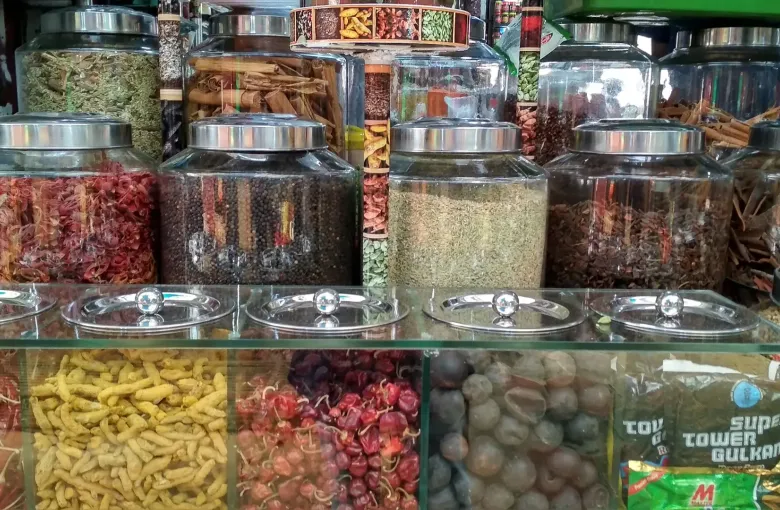
The short version.
There is no Indian cuisine in the singular, and the most useful thing this page can do is break the habit of looking for one. What is on the table changes with the region, the season, the community and the occasion, and the differences are not accents on a shared theme. The staple grain changes. The fat changes. The chili heat changes. The breads and the rices belong to different halves of the country.
The practical version: ask what the place you are standing in is known for, and order that. A restaurant that cooks one region's food well is a better meal than one that offers all of them.
A rough map, which is a starting point and not a rule.
Broadly, wheat and breads dominate the north and rice the south and east, and the fat and the spicing follow. Coastal cooking is built on fish and coconut in ways that inland cooking is not. The dry west has a tradition built around preserving and around what grows with very little water. Bengal's sweets are a discipline of their own. Every one of those sentences has exceptions a resident would give you immediately, which is the point: treat regional labels as a way to start a conversation rather than as a taxonomy.
Vegetarian eating, which is not an accommodation here.
India is the easiest country in the world to eat vegetarian in, and the reason is that vegetarian cooking here is a cuisine rather than a substitution. A thali in a vegetarian house is not a meal with the meat removed; it is a complete meal that was never built around meat. Travelers who eat vegetarian at home often eat better in India than they do anywhere. Travelers who do not should still eat this way for at least some of the trip, because a large part of what is worth eating is on that side of the line.
Be aware that vegetarian in India often means without egg as well, and that many restaurants are explicitly one thing or the other. Neither is a problem once you know to ask.
Eating safely, and what the record actually supports.
The U.S. Centers for Disease Control and Prevention destination record for India lists Hepatitis A and Typhoid, both of which are contracted through contaminated food or water, and records that cholera is presumed to be present in India. That is the basis for the standard advice about water and about food that has been sitting, and it comes from a health authority rather than from folklore.
What follows is ordinary and worth doing: drink water you are confident about, be thoughtful about ice and about raw items washed in water you are not confident about, and prefer food that is cooked to order and served hot. Busy places turn their food over quickly, which is a better signal than the price or the frontage. None of this is a reason to eat only in hotels, and doing so would mean missing most of what you came for.
The vaccination question belongs with a travel health professional rather than with this page. The UK Foreign, Commonwealth and Development Office health advice recommends seeking advice at least 8 weeks before a trip, and that is the conversation in which Hepatitis A and typhoid come up.
Street food.
Some of the best food in India is sold from a cart, and a blanket rule against it costs more than it saves. Apply the same reading you would anywhere: high turnover, cooked in front of you, hot when it reaches you. The stall with a queue has already been judged by people who eat there every day.
Spice, and what to ask for.
Heat is not the same thing as flavor, and the assumption that Indian food is uniformly hot is mostly a fact about Indian restaurants abroad. Some regional cooking is genuinely fiery and some is barely warm. Ask, and ask specifically, because mild means different things in different kitchens.
How to settle it.
Eat regionally, eat vegetarian for part of the trip, and take the water and hot-food precautions the health record supports rather than eating defensively everywhere. Then tell us what you like and we will build the food into the itinerary rather than leaving it to whatever is next to the hotel.
Sources
- U.S. Centers for Disease Control and Prevention: recommends that travelers going to certain areas of India take prescription medicine to prevent malaria, lists Japanese Encephalitis, Hepatitis A and Typhoid on its India destination record, records that cholera is presumed to be present in India, and notes an elevated chikungunya risk in India. Accessed 22 September 2026.
- UK Foreign, Commonwealth and Development Office: advises seeking advice at least 8 weeks before a trip, names dengue and malaria in India, records severe air pollution as a major health hazard especially during the winter months from October to February with north Indian cities most affected, and gives 112 as the number to dial for an ambulance. Accessed 22 September 2026.
Other Articles
India Culture and Etiquette Guide
India Travel Safety Guide